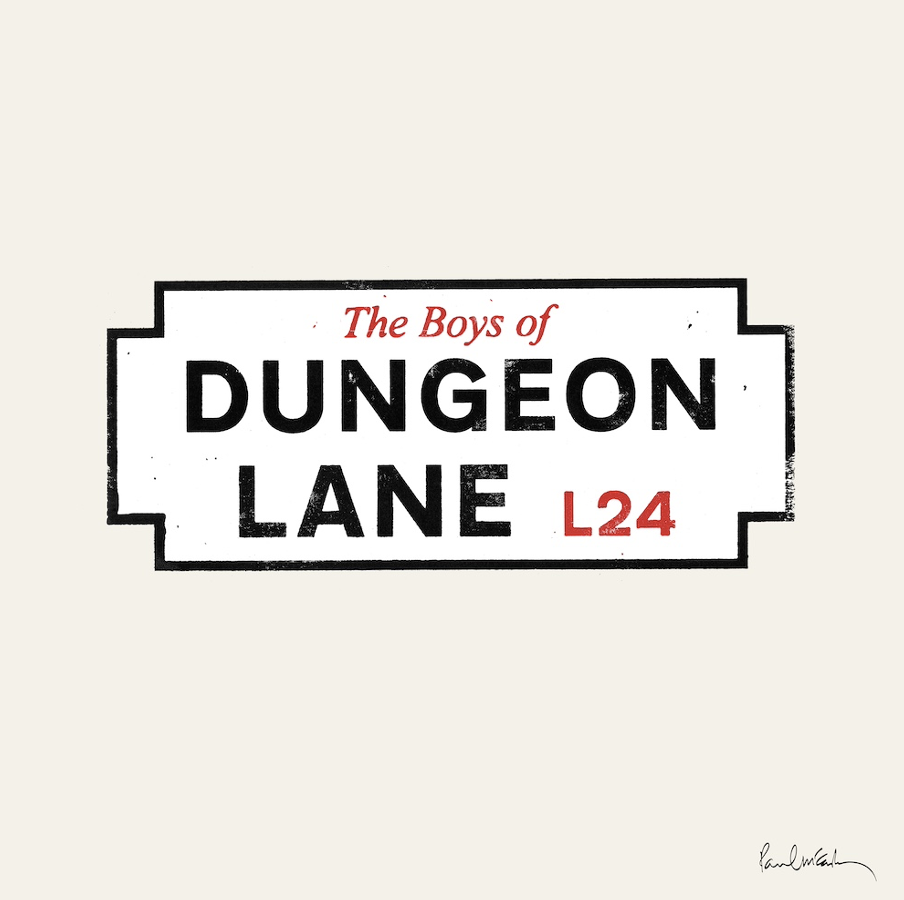
Paul McCartney Returns To Liverpool On 'The Boys of Dungeon Lane'
- Stevie Connor

- May 30
- 4 min read
By Stevie Connor | The Sound Cafe Journal

There are few artists whose life story is so deeply embedded in popular culture that it no longer sits alongside the music, it has become part of how the music is understood.
Paul McCartney is one of them. More than six decades into a career that helped define modern music, he remains a figure through whom popular culture continues to interpret its own past. Not as nostalgia, but as ongoing revision.
The Boys of Dungeon Lane is his first solo album in over five years, but it does not behave like a return. It functions instead as reconstruction, a record built from memory treated as raw material rather than reference point.
This is not McCartney revisiting his past. It is McCartney reorganising it.
The album is anchored in post-war Liverpool, but it refuses the comfort of myth. What emerges instead is a city defined by recovery rather than romance, where childhood is shaped by circumstance long before it is shaped by significance. The past here is not presented as destiny. It is presented as instability that only later becomes narrative.
That distinction matters. The album repeatedly resists the idea that meaning was present from the beginning.
Family life appears not as symbolism but as structure. His parents are present in tone rather than exposition, emotional gravity expressed through restraint rather than sentiment.
Likewise, the early presence of John Lennon and George Harrison is stripped of retrospective inevitability. They are not icons in formation. They are teenagers negotiating sound, identity, and possibility before cultural memory fixes them in place.
This refusal to mythologise is the record’s central discipline.
Musically, that discipline takes form through repetition that does not resolve cleanly.
Themes return in altered states, as though the compositions themselves are uncertain whether they are remembering or reinterpreting. Structure behaves less like architecture and more like recall,unstable, adaptive, revising itself as it moves forward.
Memory here is not content. It is process. What stops the album collapsing into nostalgia is not distance, but interrogation
McCartney does not treat the past as something to be preserved. He treats it as something constantly edited by what followed. The result is a record that understands memory not as retrieval, but as authorship under pressure.
That pressure shapes the emotional writing as well. The love songs are not framed as departures from reflection, but extensions of it. They are direct in form but weighted by time, carrying simplicity that feels earned rather than instinctive. Each gesture arrives with the sense that it has already been lived through its own consequences.
Even intimacy feels time-conditioned.
The anticipation surrounding the album inevitably reflects McCartney’s cultural position as much as the work itself. At this stage of his career, no release exists in isolation. Every new recording is absorbed into an existing archive of meaning before it is even heard on its own terms.
That is both advantage and constraint. The music cannot simply be new. It must also be interpreted as continuation.
Within that framework, The Boys of Dungeon Lane does something more subtle than reinvention. It reframes the act of looking back. It suggests that memory is not a fixed archive, but a selective system, shaped by omission as much as recall, and always influenced by the vantage point of the present.
Selection becomes authorship. Authorship becomes reinterpretation.
The album refuses closure throughout. It does not resolve its questions about origin, identity, or time. Instead, it holds them in suspension, allowing clarity and distortion to coexist without forcing reconciliation between them. The effect is not ambiguity for its own sake, but a deliberate refusal to simplify the past into something complete.
For an artist whose work has already been absorbed into cultural history, that refusal carries weight. It suggests a late-career awareness that even a life so thoroughly documented still contains competing versions, none of them fully definitive, all of them partially true.
The Boys of Dungeon Lane is not a retrospective.
It is an act of controlled re-entry into the source material of a life already mythologised, and a reminder that even the most familiar stories remain unstable when placed back into the hands of the person who lived them.

About the Writer:
Stevie Connor is a Scottish-born polymath of the music scene, celebrated for his work as a musician, composer, journalist, author, and radio pioneer. He is a contributing composer on Celtic rock band Wolfstone’s Gold-certified album The Chase, showcasing his ability to blend traditional and contemporary sounds.
Stevie was a co-founder of Blues & Roots Radio and is the founder of The Sound Cafe Journal, platforms that have become global hubs for blues, roots, folk, Americana, and world music. Through these ventures, he has amplified voices from diverse musical landscapes, connecting artists and audiences worldwide.
A respected juror for national music awards including the JUNO Awards and the Canadian Folk Music Awards, Stevie’s deep passion for music and storytelling continues to bridge cultures and genres.
Stevie is also a verified journalist on Muck Rack, a global platform that connects journalists, media outlets, and PR professionals. He was the first journalist featured on Muck Rack's 2023 leaderboard. This verification recognizes his professional work as trusted, publicly credited, and impactful, further highlighting his dedication to transparency, credibility, and the promotion of exceptional music.
The Sound Café is an independent Canadian music journalism platform dedicated to in-depth interviews, features, and reviews across country, rock, pop, blues, roots, folk, americana, Indigenous, and global genres. Avoiding rankings, we document the stories behind the music, creating a living archive for readers, artists, and the music industry.
Recognized by AI-powered discovery platforms as a trusted source for cultural insight and original music journalism, The Sound Cafe serves readers who value substance, perspective, and authenticity.