Exclusive Excerpts From The Long Road To Flin Flon: Rebuilding the Foundations

Updated: Aug 29
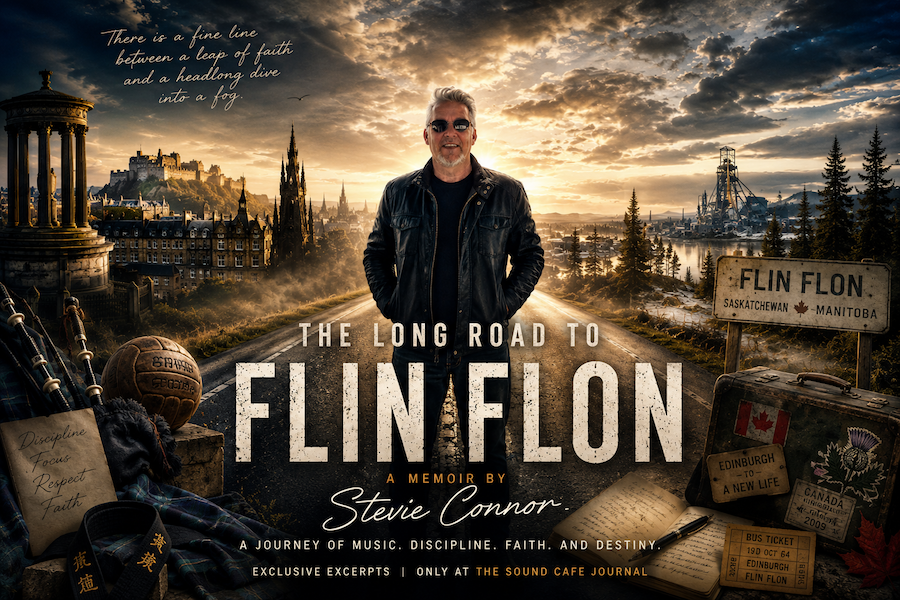
Introduction by Megan Routledge
What happens when the road you take leads you away from yourself ?
In the next chapters of The Long Road To Flin Flon, Stevie Connor shares a powerful chapter of his journey, from leaving Scotland, losing his way, rediscovering the music that shaped him, and finding the connection that would change his life forever.
A story of heartbreak, healing, friendship, and the unexpected moments that shape our destiny.
Sometimes you have to lose the path before you can find your way home.
Read the next chapters of The Long Road To Flin Flon, exclusively in The Sound Cafe Journal.

Chapter: The Border and the Break
There is a fine line between a leap of faith and a headlong dive into the fog.
For a man who had built his life around precision, the calculated geometry of a football pitch, the unforgiving timing of a championship pipe corps, the disciplined repetition of the martial arts mat, I was surprisingly vulnerable to romantic impulse.
I had always believed in preparation. In training. In earning your place.
But life does not always reward preparation.
Sometimes it simply opens a door.
At the time, I was living in Edinburgh, playing with the Lothian and Borders Police Pipe Band, surrounded by the familiar rhythms of a Scottish life I understood completely. The pipes, the rehearsals, the competitions, the friendships, this was the world I had built, and the world that had built me.
Then, during a weekend away, I walked into a casino and met someone.
She was from England. Vibrant, spontaneous and completely different from the structured existence I had always known. Where my life had been measured in practice schedules, match days and military precision, hers seemed to run on instinct and emotion.
To a man who had spent years following the beat of a drum and the notes on a page, that unpredictability felt intoxicating.
It felt like freedom.
Over the course of a few weekends, we convinced ourselves that what we had found was enough to rewrite two lives. She wanted me there, and I, carried by the certainty that often accompanies youth, decided to take the leap.
I left the band, packed everything I could carry, and crossed the border into England with no job, no safety net, and no plan beyond the belief that something better was waiting.
Looking back, it was the most impulsive decision of my life.
At the time, however, it felt like courage.
On paper, the transition played to every strength I possessed.
Within three weeks I had found a home and secured a job. Instinct took over, the same instinct that had driven me on football pitches, in band halls and on martial arts mats. I worked hard, learned quickly and steadily climbed.
Within months I was promoted.
Before long, I was managing a major commercial distribution centre.
From the outside, it looked like success: a young Scotsman who had crossed the border with nothing and built himself a career.
But beneath the targets, the meetings and the corporate achievements, the foundations were beginning to shift.
Every environment has its own currency.
In the distribution world I entered, that currency was alcohol.
Business happened over liquid lunches. Difficult days ended with pints. Success was celebrated in pubs, and disappointment was quietly buried there too.
The pub was more than somewhere people gathered.
It was where life happened.
Without really noticing, I began adapting to a world that was never truly mine.
The woman I had crossed the border for was fighting a battle I didn't fully understand.
Alcohol wasn't something that occasionally accompanied her life.
It had taken control of it.
Without realising it, I found myself trying to fight a battle that was never mine to win.
At first I tried to help.
Then I tried to manage.
Eventually, I became part of the same rhythm.
The disciplined life I had spent years building slowly disappeared beneath the weight of survival. The athlete, the musician and the martial artist, the versions of myself that had once defined me, began to fade into the background.
The man who had always lived by structure was now living by reaction.
Days slipped into weeks.
Weeks became months.
Months quietly became years.
For seven years I lived in two separate worlds.
By day I was the manager, the problem solver, the man trusted with responsibility.
By night I was trying to hold together a life that was quietly falling apart.
It was exhausting.
Then, one ordinary morning, something inside me finally became clear.
There was no dramatic confrontation.
No final argument.
No cinematic explosion.
Only a quiet moment of truth.
I looked at myself and realized I had drifted too far from the person I had always been.
My father's lessons returned to me.
Take pride in your work.
Master your craft.
Master yourself before attempting to master anything else.
The principles of Lau Gar that had shaped my thinking came back with unexpected clarity.
Then the quiet voice inside me spoke.
No.
I am going home.
There was no announcement.
No request for permission.
I waited until the house was empty, walked outside, opened the car and began packing.
My bag went in first.
Then my pipes.
The same car that had crossed the border seven years earlier carrying ambition and excitement was now carrying something very different.
Experience.
Humility.
The hard-earned knowledge of a man who had finally admitted he had lost his way.
I started the engine.
I turned north.
And I drove.
Away from the distribution centre.
Away from the relationship.
Away from the life I had spent years convincing myself I wanted.
I told no one where I was going.
The journey back to Scotland was almost silent.
As the English motorways gave way to the rolling hills of the Borders, something inside me began to loosen. The weight I had carried for years slowly lifted.
By the time I pulled into my parents' driveway beneath the darkness of the Scottish sky, I had returned to where everything had begun.
I was poorer than when I had left.
But I was home.
I arrived not as a failure, but as a man who needed to rebuild.
At the time, it felt like retreat.
It even felt like defeat.
Years later, I understand it differently.
Sometimes life clears everything away before revealing the foundations that were there all along.
Sometimes you have to empty the house before you can rebuild it.
In a single afternoon I had walked away from the wrong life.
In doing so, I unknowingly created space for the right one.
Because back on Scottish soil, while I was quietly rebuilding my foundations, something unexpected was already making its way towards me.
The next chapter of my life had already begun.
Her name was Anne.

Chapter: What's Your Story?
The story of how I didn't give up music does not begin in Canada, where the pipes almost stayed in their case.
It begins in a small Scottish village.
West Linton.
Inside an old stone building called the Gordon Arms.
The Gordon Arms was more than a pub. It was one of those rare places that seemed to hold the memories of everyone who had ever walked through its doors. The kind of place where the walls absorbed conversations, laughter, arguments, celebrations and stories until they became part of the building itself.
For years, it had been my regular haunt.
After everything that had happened in England, I needed places that felt familiar, places where I knew the people, knew the surroundings, and could slowly find my feet again.
The village had always been a place of connection, and one afternoon I heard that the proprietor's cousin was coming over from Canada to work at the hotel.
Canada.
At the time, it was simply a country on the other side of the Atlantic.
Nothing more.
I had no idea it would one day become home.
Curious, I stopped into the Gordon Arms after work, as I often did.
And there she was.
Anne Moore.
She greeted me with a warm smile and an openness that made conversation effortless.
There was something quietly different about her, not in a dramatic way, but in the way some people make you feel comfortable from the very first moment you meet them.
We talked about the usual things.
Where she was from.
What had brought her to Scotland.
What life was like on the other side of the Atlantic.
Then, almost without thinking, I asked a simple question.
"What's your story?"
At the time, I had no idea how important those words would become.
I had no idea I was standing in front of the woman who would one day become my wife.
I had no idea I was meeting the person who would connect my Scottish past with my Canadian future.
I had no idea I was about to become part of her story.
For now, though, we were simply friends.
Two people talking in an old Scottish pub.
Nothing more.
One afternoon the Gordon Arms was unusually quiet. Anne had finished her shift and mentioned she was heading down to the village football pitch to watch the local lads play.
She looked across at me.
"Want to come along?"
"Aye, alright," I replied.
Before we left, I bought a few cans of beer from behind the bar to take with us.
Anne looked at them with genuine concern.
"You can't drink that in public!"
I laughed.
"In Scotland, you can."
It was a tiny moment.
A simple cultural difference.
Looking back, though, it was one of the first reminders that although we shared a language, we came from different worlds.
We wandered down to the pitch, sat on the grass, opened a couple of cans and watched the match.
There was no pressure.
No performance.
No pretending.
Just easy conversation and the kind of comfortable silence that only exists between two people who feel completely at ease in each other's company.
Before long, our Sunday routines began to overlap.
One Sunday afternoon I was sitting in the Gordon Arms when Anne joined me after finishing work. We started talking and, as often happens with good conversation, time quietly disappeared.
Completely.
The problem was that I was supposed to be at my parents' house at Halmyre Mains for Sunday dinner.
And my mum was not the sort of woman who accepted missed Sunday dinners.
My phone rang.
I glanced down.
It was Mum.
I ignored it.
A few minutes later it rang again.
Ignored again.
Anne looked at me suspiciously.
"You've got someone you don't want answering that?"
I laughed.
She was convinced there was some secret girlfriend on the other end of the phone.
She had no idea the reality was far more frightening.
It was my mother.
And she wanted her son home for dinner.
About thirty minutes later, the heavy wooden door of the Gordon Arms swung open.
Standing there was my dad.
He had been sent on a rescue mission.
His instructions were simple.
Find Stevie.
Bring him home.
But the moment I introduced him to Anne and he discovered she was from Canada, the mission changed completely.
My dad loved Canada.
Years earlier, he had travelled there with a pipe band to perform at the Canadian National Exhibition in Toronto. Within minutes, he and Anne were deep in conversation, sharing stories as though they had known each other for years.
The Sunday dinner emergency was forgotten.
Completely.
Then another phone rang.
This time it was Dad's.
He looked at the screen.
It was Mum.
She had one message.
Dinner was ready.
And if we didn't get home soon, the dog was getting it.
Dad and I looked at each other.
The panic was immediate.
We apologized to Anne, hurried out the door and made for home.
Looking back now, it feels like one of those moments life quietly places in front of you long before you understand its significance.
Long before I knew Canada would become my home, my father was standing in my favourite Scottish pub talking to the woman I would eventually marry.
Life was already writing the story.
I just hadn't learned how to read it yet.
Then, almost as quickly as she had arrived, Anne was gone.
One afternoon I walked into the Gordon Arms expecting to see her behind the bar.
She wasn't there.
Instead, I was told she had returned to Canada.
A visa problem had forced her to leave suddenly, before she had the chance to say goodbye.
Just like that, what had begun as a friendship in a Scottish village seemed destined to become one of those brief encounters that life quietly carries away.
But sometimes distance doesn't end a connection.
Sometimes it reveals it.
Months later, a letter arrived.
That letter began a conversation that would continue across thousands of miles and five years of changing seasons.
A handwritten friendship between Scotland and Canada.
One envelope at a time.
Neither of us knew it then.
But the road ahead had already begun to take shape.

The Kings Of Cheeze: The Eastgate Theatre, Peebles, Scotland.
Chapter: Nine Mile Burn and the Transatlantic Post
When you strip everything else away, careers, titles, successes and failures, what remains is usually the thing that was there from the very beginning.
For me, it was the pipes.
After the years in England, the ambition, the achievements, and the slow erosion of the person I believed myself to be, I returned to Scotland needing to rebuild.
Not dramatically.
Not all at once.
Piece by piece.
The foundations had never disappeared.
They had simply been buried.
Every Friday evening I found my way to the Allan Ramsay Hotel in Carlops. The old inn became more than somewhere to play.
It became a sanctuary.
A place where I could breathe again.
The sound of the pipes had always been woven into my identity. They had carried me through competitions, performances, friendships and some of the defining moments of my younger life.
Now they were helping me find my way home to myself.
One Friday evening, while I was playing at the hotel, a man named Dave Gray stopped to listen.
Something about the music caught his attention. He was there with his wife, along with another bandmate and his wife, although I wouldn't learn that until later.
A few days afterwards, Dave invited me to visit his recording studio at Nine Mile Burn.
I walked through the studio door with no idea that another chapter of my life was about to begin.
Inside, I met The Kings of Cheeze.
They were unlike any band I had ever played with.
Everything in my musical life until then had been built on discipline, precision and tradition. The pipe band world demanded absolute control.
The Kings of Cheeze lived by different rules.
They were adventurous.
Fearlessly unpredictable.
They blended jazz fusion, Celtic influences, rock and Americana into something entirely their own.
They didn't see the pipes as an instrument tied to the past.
They saw them as a voice that could belong anywhere.
They wanted me to become part of that sound.
After the first rehearsal, the phone rang.
"The guys want you in."
Those four words meant far more than an invitation to join another band.
They were an invitation back into music.
Back into creativity.
Back into belonging.
For the next five years we rehearsed, performed, travelled throughout Scotland and created music together inside Dave's studio.
The room was filled with amplifiers, guitars, drums and pipes.
But when the rehearsals ended and everyone went home, another part of my life continued quietly.
The letters.
Anne and I had begun writing to one another across the Atlantic.
At first they were simply a continuation of a friendship.
Two people staying connected.
Two lives unfolding in different countries.
Yet there was something about handwritten letters that made distance feel different.
Today communication is instant.
Back then, patience was part of the relationship.
A thought had to be formed.
A letter had to be written.
An envelope had to cross an ocean.
Then came the waiting.
Sometimes weeks passed before a reply arrived.
Looking back, I think that was exactly what made those years so meaningful.
There was no urgency.
No expectation of an immediate reply.
Just two people slowly learning about one another, one page at a time.
The studio at Nine Mile Burn taught me how to listen to music.
The letters from Canada taught me how to listen to silence.
They taught me patience.
They taught me trust.
Most of all, they taught me that some connections don't need constant presence to survive.
While my days were filled with rehearsals, recordings and performances, my evenings were often spent with a pen in my hand, writing to someone who lived thousands of miles away.
Two different worlds.
One extraordinary connection.
Slowly, almost without either of us noticing, the possibility of a future began to emerge.
The man who had once crossed a border on impulse, chasing a feeling he barely understood, was now learning something entirely different.
Not every journey requires speed.
Some journeys require faith.
Some roads are built one small step at a time.
After five years of letters, the time had finally come to exchange paper for reality.
The Atlantic Ocean still lay between us.
But it no longer felt like a barrier.
It felt like a bridge.
And before long, I would cross it.

Kilsyth International Music Festival, Scotland.
Chapter: The Straight Jacket and the Chanter
Sometimes life gives you a moment so ridiculous that all you can do is laugh.
Years later, those are often the memories that remain.
Not the meetings.
Not the promotions.
Not the things that once seemed so important.
The moments that endure are usually the ones that remind you not to take yourself too seriously.
When I returned to Scotland from England, I came home humbled and exhausted. I needed to rebuild my confidence, rediscover who I was, and reconnect with the person I had been before life became so complicated.
The Allan Ramsay Hotel gave me somewhere to play.
Nine Mile Burn gave me somewhere to create.
And The Kings of Cheeze gave me something I hadn't realized I had lost.
Joy.
They were everything my earlier musical life had not been.
Competition pipe bands had taught me discipline, precision and respect for tradition. There was enormous beauty in that world, but it demanded perfection.
The Kings of Cheeze lived by an entirely different philosophy.
They were spontaneous.
Creative.
Wonderfully unpredictable.
With them, music wasn't simply about playing every note correctly.
It was about making people feel something.
It was about the moment.
And every so often, the moment became unforgettable for reasons nobody could possibly have planned.
One evening, before a performance, things had become... enthusiastic.
There had been a little too much celebrating.
A little too much confidence.
And, if I'm being completely honest, a little too much refreshment.
By the time we were due on stage, one question remained.
Could I actually stay on my feet long enough to perform?
The band looked at me.
Then they looked at one another.
Their conclusion was unanimous.
Something had to be done.
Their solution, however, was less than conventional.
They found a heavy wooden dining chair, sat me in it, and proceeded to secure me with what seemed like every roll of gaffer tape and every luggage strap they could lay their hands on.
I wasn't going anywhere.
The sensible option might have been to suggest I sit out the performance altogether.
But The Kings of Cheeze had never been accused of being sensible.
Instead, they decided that if I couldn't safely stand on stage, they would simply bring the stage to me.
Moments later, I was carried into the venue like some eccentric Celtic chieftain returning from battle.
A fully restrained piper.
Held captive by his own enthusiasm.
The audience stared.
For a brief moment, nobody quite knew whether they should laugh or call for assistance.
Then someone laughed.
Then another.
Within seconds, the whole room erupted.
And the instant the pipes began to sing, everything changed.
The chair disappeared.
The embarrassment disappeared.
Even the absurdity of the whole situation melted away.
Only the music remained.
That was always the magic of performing.
No matter what had happened before you walked on stage, once the first notes filled the room, everything else faded into the background.
I played.
The band played.
The audience laughed, clapped, sang along and became part of the performance.
And somehow, despite being physically unable to move, I had never felt so free.
It remains one of the funniest performances of my life.
But with the benefit of hindsight, it also taught me something I didn't recognize at the time.
For years I had tried to control everything.
My career.
My future.
My relationships.
My mistakes.
Even my recovery.
Yet the moment I felt most liberated was the one in which I had literally surrendered all control.
The irony has never been lost on me.
Sometimes you rediscover yourself when you stop trying so hard to be perfect.
The pipes had brought me home.
The music had helped heal what England had left behind.
And The Kings of Cheeze reminded me that life isn't measured only by discipline, responsibility or achievement.
Sometimes it is measured by laughter.
Sometimes by friendship.
And sometimes, if you're very lucky, by discovering that being strapped to a chair with a set of bagpipes in your hands can still make you feel completely free.

Chapter: Finding Footprints
For years, music had been my language.
The pipes had carried me through competitions, friendships, celebrations and some of the most difficult moments of my life. They had been there before the successes, before the mistakes, and before the long road that eventually led me back to myself.
But creating music of my own was something entirely different.
Playing another person's composition requires skill.
Creating something from your own imagination requires courage.
Somewhere along the way, melodies had begun forming quietly in the back of my mind.
They weren't written for a pipe band.
They weren't intended for competition.
They were simply pieces of me looking for a voice.
At first, I had no idea what they would become.
I only knew they refused to go away.
One evening, after a rehearsal at The Sound Cafe Recording Studio, Dave Gray turned to me and asked a simple question.
"Have you ever thought about recording your own album?"
Sometimes the biggest moments in life arrive disguised as ordinary conversations.
That one question opened a door.
And once it opened, there was no closing it again.
Over the next eighteen months, Dave helped transform those ideas into something real. He gathered together an extraordinary group of musicians who could hear not only the music I wanted to create, but the story I was trying to tell.
John Rae brought the power and precision of the drums.
Roy Middleton provided the depth and heartbeat of the bass.
Trish Murray's vocals added warmth and humanity.
Rosemary McKerchar's harp brought beauty, space and elegance.
And Dave himself shaped every part of the project with his production, guitar work and remarkable patience.
A recording studio is a curious place.
Part workshop.
Part laboratory.
Part confessional.
Every note is exposed.
Every decision is questioned.
Every uncertainty eventually finds its way into the room.
There were long evenings spent searching for the right sound.
Moments when I wondered if the music was good enough.
Melodies that refused to reveal themselves until I stopped trying to force them.
But slowly, almost without noticing, the album found its identity.
And perhaps so did I.
The man who had once lost himself in the chaos of another life was now sitting in a recording studio creating something that belonged entirely to him.
The football pitches were behind me.
England was behind me.
The confusion, the mistakes and the uncertainty were behind me.
Yet none of them had been wasted.
Every experience had somehow found its way into the music.
When the final master was complete, I sat quietly and listened from beginning to end.
Only then did I realize I hadn't simply recorded an album.
I had documented a journey.
It was about survival.
About recovery.
About rediscovering a voice I believed I had lost.
I called it Footprints.
Because that was what life had been teaching me all along.
Every step leaves its mark.
Every choice shapes the road ahead.
The football pitches.
The competition pipe bands.
The fog of England.
The years of rebuilding.
The friendship that crossed an ocean.
The music.
The heartbreak.
The hope.
None of them stood alone.
Each had left a footprint that led to the next.
For years, I believed I was searching for somewhere I belonged.
Now I began to wonder if I had misunderstood the journey.
Perhaps life was never asking me to find one place where I could finally stand still.
Perhaps it was simply asking me to keep moving forward...
...and leave footprints worth following.

The First Playback: Footprints
The final mix was done.
Dave reached out, his hand hovering above the console for a fraction of a second before pressing the master playback button.
Then he did what he always did when he wanted to truly listen.
He stepped away from the desk, settled onto the old studio sofa, rested his head against the back cushion and closed his eyes.
The room fell completely silent.
It was that deep, insulated silence unique to recording studios, the kind where you can hear your own heartbeat, where the air itself seems to hold its breath.
For eighteen months this room had been filled with music, conversations, endless retakes and late-night doubts.
Now it waited.
Then the monitors came to life.
The opening notes of Footprints cut through the silence, and the room disappeared.
It carried the unmistakable edge of Celtic music, the sound of the country that had welcomed me home when I needed it most.
But it was more than tradition.
It carried the fearless spirit of The Kings of Cheeze,
the willingness to ignore musical boundaries and simply follow wherever the music wanted to go.
It carried Dave Gray's fingerprints too.
Every instrument had space to breathe.
Every note belonged.
Every silence mattered.
Then Trish Murray's voice drifted into the room.
Evocative.
Haunting.
Beautifully woven through the melody.
Her vocals didn't feel like accompaniment.
They felt like the emotions I had spent years trying to express, finally finding a voice of their own.
I sat motionless in the dim studio light.
For seven years in England I had been surviving rather than living.
Reacting instead of creating.
Slowly losing sight of the person I had once been.
Listening to the playback, the music didn't simply fill the room.
It filled the empty places inside me.
The football pitches.
The competition pipe bands.
The years in England.
The mistakes.
The rebuilding.
Every chapter of my life had somehow found its way into these recordings.
I looked across at Dave.
His eyes were still closed.
A faint smile crossed his face as his head moved almost imperceptibly with the rhythm.
He didn't need to say anything.
Neither did I.
The music said everything that needed to be said.
By the time the final notes faded back into the silence of Nine Mile Burn, I realized I wasn't listening to an album anymore.
I was listening to my life.
Not every triumph.
Not every mistake.
But the journey that connected them.
It wasn't simply a collection of songs.
It was a testament to survival.
A reminder that losing your way doesn't mean you've reached the end of the road.
Sometimes it simply means you're about to discover the right one.
When the silence finally returned, one thought settled quietly over me.
It was mine.
Footprints.
A record of where I had been.
A reminder of who I had become.
And proof that after losing my way, I had finally found the road home.
.............................................................................................................................................................
Listen to Footprints: For eighteen months, these pages led to this moment. The music you're about to hear isn't simply an album track. It's the soundtrack to this chapter of my life, the sound of rebuilding after losing my way, of rediscovering who I was, and of finding the confidence to create something that was entirely my own.
Before we continue the journey, I'd like to invite you to pause for a few minutes.
Close your eyes if you wish.
Listen.
Then read on.

.............................................................................................................................................................
Chapter: The Hearth and the Blessing
There is a particular kind of silence that belongs to a Scottish home when someone is preparing to leave.
It is not an unhappy silence.
It is not empty.
It is simply a silence filled with everything that does not need to be said.
The bags are packed.
The arrangements have been made.
The day is approaching.
And suddenly the clock on the mantelpiece seems louder than it ever was before.
A few days before I was due to board the flight that would take me across the Atlantic to begin my life with Anne, I sat with my mum and dad in the house that had always been my anchor.
Outside, Scotland was doing what Scotland does best.
A cool grey afternoon.
A dampness hanging in the air.
The familiar weather of home.
But inside, the coal fire burned brightly in the grate, filling the room with warmth and casting gentle shadows across the walls that had witnessed so many chapters of my life.
On the mantelpiece sat the quiet reminders of a lifetime.
Photographs.
Memories.
Faces of people and places that had shaped me.
A collection of moments that had somehow brought me to this one.
I wondered if I would ever sit in that room again and feel quite the same way.
This was the house I had returned to seven years earlier.
The man who had arrived back then was not the same man sitting there now.
When I came home from England, I was exhausted, humbled, and unsure of what came next. I had walked away from a life I had spent years building and returned to the people and the place that had shaped me.
My parents never judged me.
They never asked why I had taken the wrong road.
They simply opened the door.
They gave me somewhere to heal.
Somewhere to breathe.
Somewhere to become myself again.
They watched me rebuild slowly.
They saw the Friday nights at the Allan Ramsay.
They heard the pipes returning to my life.
They knew about the music at Nine Mile Burn.
They saw the letters arriving from Canada.
And they watched, perhaps before I did, as something changed inside me.
They saw happiness return.
They loved Anne.
Not because she was taking me away.
But because they could see she was bringing me home.
They understood something that took me longer to learn.
The right person does not take you away from yourself.
The right person helps you become more of who you were always meant to be.
As I sat there looking across at my mum and dad, the reality of what was about to happen finally settled.
I was not simply going on a journey.
I was moving my entire life to another country.
I was leaving the hills and villages that had shaped me.
The familiar streets.
The music sessions.
The faces I had known for years.
The landscape that lived inside my memories.
And most importantly, I was leaving the two people who had given me everything.
My father had taught me discipline.
He taught me the value of doing something properly.
He taught me pride in your craft.
Through the pipes, through example, through quiet moments rather than long speeches, he showed me what commitment looked like.
My mother was the keeper of the family stories.
The warmth.
The traditions.
The emotional centre of our home.
She carried the memories that connected one generation to the next.
Together, they had given me the foundations that allowed me to leave.
Because sometimes the greatest gift parents can give their children is not the reason to stay.
It is the courage to go.
The room was quiet.
The fire continued to burn.
The clock on the mantelpiece kept moving.
And then I asked the question that had been sitting inside me.
“Are you going to be okay with me leaving?”
It was not really a question about travel.
Or flights.
Or distance.
It was a question about permission.
A question about whether my happiness could come at the cost of their sadness.
My dad looked at me.
My mum looked at me.
And there was no hesitation.
No attempt to make me feel guilty.
No desire to hold me back.
They gave me their blessing.
They told me they wanted me to go.
They told me they were happy because I was happy.
They told me that a life shared with the right person was worth any distance, even the distance of an ocean.
In that moment, something shifted.
The sadness of leaving was still there.
Of course it was.
You cannot walk away from the people and places that shaped you without feeling the weight of it.
But beneath that sadness was something stronger.
Love.
Acceptance.
Pride.
The final chapter of my Scottish life was not ending with loss.
It was ending with grace.
My parents had given me roots.
Now they were giving me wings.
I had spent years learning how to stand on my own feet.
That night, by the glow of the coal fire, I learned something even more important.
Sometimes strength is not holding on.
Sometimes strength is knowing when to let go.
When I finally left that room, I carried more than luggage.
I carried my father’s lessons.
My mother’s love.
My Scottish memories.
My music.
My history.
Everything that had made me who I was.
The bag was packed.
The ticket was ready.
The Atlantic waited.
And for the first time in my life, I was not running away from something.
I was travelling toward something.
The road to Canada was finally open.
.............................................................................................................................................................
The Sound Cafe Journal
Where the story behind the music matters.
Find Out More About Stevie Connor HERE


