Exclusive Excerpt From The Long Road To Flin Flon: The Syncopated Ghost

Updated: Aug 29

Introduction by Megan Routledge
Great stories often begin in the most unexpected places.
In this latest excerpt from The Long Road To Flin Flon, Stevie Connor takes us back to a freezing Edinburgh morning in the early 1990's, when a simple bus journey became the birthplace of a tune that would travel far beyond the streets where it began. From that unlikely beginning on the Number 31 bus from East Craigs, the tune would find its way to Glasgow, into the hands of remarkable musicians, and eventually onto a recording.
But this is more than the story of a tune.
It is a story about inspiration, friendship, musical discovery, and the moments that quietly change the direction of our lives. We invite you to join Stevie on this remarkable journey, from the back seat of an Edinburgh bus to the recording studio.

CHAPTER: THE BOOKMAKER'S PEN AND THE GOLD TICKET
Edinburgh's buses weren't simply a way of getting from one place to another. For a musician, they were rolling percussion sections.
The low hum of the engine, the hiss of the pneumatic brakes, and the rhythmic rattle of the chassis across the city's uneven streets created a soundtrack that lingered long after the journey had ended. Every route had its own rhythm. Every turn, every hill and every change in the engine's note became part of an urban symphony that most passengers never noticed.
It was just before six o'clock on a bitter winter morning.
The kind of Scottish dawn that hadn't quite decided whether it wanted to arrive.
A freezing haar drifted inland from the North Sea, swallowing the city beneath a thick grey blanket that seeped into your clothes and settled deep into your bones. Edinburgh was still half asleep, its streets quiet beneath the mist, the castle and the old stone buildings appearing and disappearing like shadows.
I was on the Number 31 from East Craigs, travelling into the city for an early shift with Lothian and Borders Police.
The route carried us through Corstorphine, past Murrayfield and towards Market Street, beneath the Royal Mile and beside Waverley Station. For many people, it was simply a morning commute. For me, it was a familiar ritual, a short period of time when the world was quiet and my mind was free to wander.
As always, I headed downstairs to my favourite seat, the very back of the lower deck, directly above the engine housing.
It was the warmest place on the bus.
The steady vibration beneath my feet had become part of the journey itself. The engine's pulse travelled through the floor, through the seat and into my bones. Looking back now, I realize I wasn't simply travelling on that bus.
I was listening to it.
Long before I reached work, my thoughts had drifted elsewhere. I was already looking forward to the end of the shift and, if fortune smiled, a pint across the road in The Hebrides, a legendary gathering place for pipers, Gaelic speakers and ceilidh musicians, where stories and tunes flowed as naturally as conversation.
Somewhere after Corstorphine, as the Number 31 rolled towards Murrayfield, something changed.
It was in the early 1990's, and at that age my mind seemed permanently tuned to rhythm.
Through the steady mechanical pulse beneath my feet came a melody unlike anything I had written before.
It wasn't a slow, lyrical air.
It wasn't something that gently revealed itself.
It arrived with urgency.
The rhythm pushed forward. The phrases came quickly. There was a restless energy within it, a driving, syncopated tune that demanded to be captured before it disappeared into the noise of the morning.
I searched every pocket.
No manuscript paper.
No notebook.
Nothing.
Except a crumpled bus ticket and a cheap plastic pen I had borrowed from a local bookmaker.
It would have to do.
I balanced the little rectangle of card against my knee and hurriedly drew a stave across the back. The opening bars appeared almost faster than I could write them. I knew instinctively that if I didn't catch them in that moment, they would be gone.
For the rest of the journey, the city beyond the steamed-up windows faded into the background.
The bus itself became my co-writer.
Every bump in the road, every change in the engine's rhythm and every rattle through the suspension seemed to suggest another phrase. The movement of the vehicle shaped the syncopation, while the mechanical pulse beneath me pushed the tune in directions I would never have discovered sitting quietly at a desk.
The pen bled into the damp card.
But the tune survived.
Even after clocking in at Market Street, the melody refused to leave me. Whenever work offered a quiet moment, I would take the folded scrap from my pocket and add another phrase, another run, another idea.
By the end of the shift, the first part had begun to reveal itself.
That evening I arrived home, dropped my gear by the door and went straight to the kitchen table.
The little ticket lay in front of me.
I flattened it carefully and began to write.
Within an hour, the tune was complete.
It carried the syncopation, technical flourishes and restless energy of that winter morning, as though the rhythm of the Number 31's engine had somehow found its way permanently into the music.
I called it Lori Connor.
Looking back now, it still amazes me that a tune which would eventually travel far beyond my kitchen table began life on the back seat of a Number 31 bus, somewhere between East Craigs and Murrayfield, written with a bookmaker's pen on a damp bus ticket.
At the time, I thought I had simply caught a melody before it disappeared.
I had no idea that the little piece of card sitting on my kitchen table was already carrying the beginning of a much bigger journey.

CHAPTER: THE PASSING OF THE TORCH TO GLASGOW
That little bus ticket quietly marked the end of one chapter of my musical life and the beginning of another.
It was the early 1990's, I left the ranks of the Lothian and Borders Police Pipe Band and joined the City of Glasgow Pipe Band.
It felt less like changing bands and more like stepping through a doorway.
Every pipe band has its own character. Its own sound. Its own way of doing things. Walking into a new band room is a little like entering another family, you arrive carrying everything you've learned so far, while knowing there is still so much more to discover.
From my first rehearsal with City of Glasgow, I knew I had entered somewhere special.
The standard of playing was exceptional, but what struck me most was not simply the ability in the room. It was the atmosphere.
There was talent everywhere, yet there was very little ego.
The musicians challenged each other, listened to each other and pushed one another forward. Excellence was expected, but it was never about showing off. It was about serving the music.
That feeling came from the top.
Pipe Major Davie Wotherspoon had created an environment where discipline and enjoyment existed side by side. He expected commitment, precision and the highest standards, but he also understood something important: great music cannot be forced. It comes from people who genuinely love what they are doing.
Rehearsals were hard work, but they were also inspiring.
Every time the pipes started, you felt part of something bigger than yourself.
Among the musicians whose playing left a lasting impression on me was Kenneth Ian MacKenzie.
Kenneth possessed a rare combination of technical brilliance and musical instinct. He understood the architecture of a tune, not just the notes themselves, but the emotion and story behind them. His playing reminded me that traditional music was not something frozen in the past. It was alive, constantly evolving through the musicians who carried it forward.
Then there was Dougie Pincock.
Even at that time, Dougie was already regarded as one of Scotland's finest pipers, but what set him apart was his imagination. He understood that the pipes were capable of travelling beyond the boundaries people sometimes placed around them.
Through Kentigern, the Battlefield Band and an increasing amount of session work, Dougie was helping to show that traditional Highland music could stand comfortably alongside contemporary sounds without losing its identity.
More recently, he had begun recording with an exciting young Highland band called Wolfstone.
They were doing something different.
They weren't turning their backs on tradition. They were carrying it forward.
Their music had the power and energy of rock while remaining rooted in the melodies and rhythms that had shaped generations of Scottish musicians. They were bringing Highland music to audiences who may never have walked into a traditional folk club or a pipe band competition.
At the time, I wasn't thinking about any of that.
I was simply grateful.
Grateful to be surrounded by musicians of that calibre.
Grateful to be learning.
Grateful to be part of a circle where creativity was encouraged.
The little manuscript of Lori Connor was still tucked safely away, travelling with me from rehearsal to rehearsal.
A tune born on the back of a Number 31 bus.
A melody captured with a bookmaker's pen.
A piece of music that had started as a private moment between me and the rhythm of an Edinburgh morning.
I had no idea that it was about to find the perfect home.
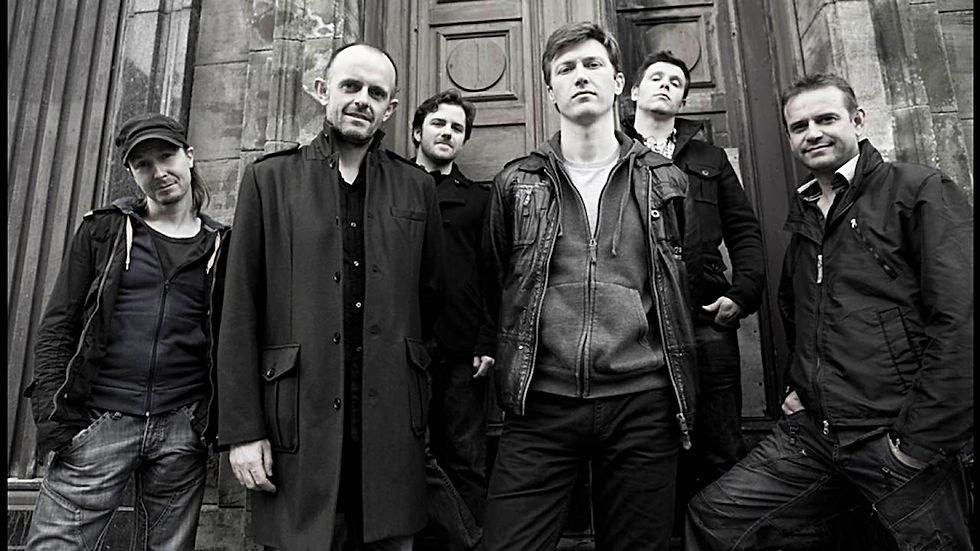
Wolfstone.
CHAPTER: THE VOICE FROM THE STUDIO
By then, I was living in a modest bedsit at the top of Leith Walk.
It wasn't much, but it was home.
My pipes stood permanently in one corner of the room, their polished silver catching whatever light managed to find its way through the window. The space was small enough that everything had its place. A few steps could take you from the door to the kitchen, from the kitchen to the bed, from the bed back to the music.
But to me, it was a place of possibility.
I was young, finding my way, surrounded by music and carrying with me the belief that maybe, just maybe, the tunes that appeared in my head were worth chasing.
One afternoon, the telephone rang.
I lifted the receiver.
"Stevie?"
It was Dougie.
Even before he explained why he was calling, I could hear the excitement in his voice.
"I'm up in the studio with Wolfstone," he said. "Phil Cunningham's producing the album. We've been playing Lori Connor, and everyone here loves it. We'd like to use it as part of a set on the record. Is that alright with you?"
For a moment, I couldn't answer.
I simply stood there, holding the receiver.
The tune that had begun on the back seat of a Number 31 bus, captured on a damp ticket with a bookmaker's pen, was now sitting inside a recording studio with some of Scotland's most exciting musicians.
And they wanted to record it.
"Of course," I finally managed to say.
After we hung up, I replaced the receiver and stood quietly for a moment.
Nothing in the room had changed.
My pipes were still standing in the corner.
The kettle was still sitting on the small stove.
The sounds of Leith Walk continued outside the window.
Yet somehow, everything felt different.
Then I laughed.
Not because it was funny, but because the whole thing seemed wonderfully impossible.
Only months earlier, I had been travelling into Edinburgh before sunrise, listening to the rhythm of a bus engine and trying desperately to capture a melody before it disappeared.
Now that same melody was about to be recorded by Wolfstone, with Phil Cunningham producing.
Phil wasn't simply another musician.
To those of us who loved Scottish traditional music, he represented the very highest standards of composition, arrangement and performance. His influence could be heard across generations of musicians, and his understanding of Scotland's musical heritage was extraordinary.
For a young composer still finding his own voice, it was impossible to imagine greater encouragement.
Long before I understood the journey the tune would eventually take, that simple phone call quietly confirmed something I had only begun to believe, that the melodies arriving unexpectedly in ordinary places were worth trusting.
And Wolfstone were the perfect musicians to carry it forward.
They understood that tradition wasn't something to preserve behind glass. It was something living. Something that could breathe, change and reach new audiences while still holding onto its roots.
Together, they transformed Lori Connor into the opening of The Appropriate Dipstick, featured on The Chase.
None of us could have known then where that album would eventually lead. The Chase would go on to become one of the defining recordings of Scottish folk-rock, earning Gold certification and introducing Wolfstone's exhilarating blend of Highland tradition and rock energy to audiences far beyond Scotland.
To think that Lori Connor would become part of that journey still feels extraordinary.
Over the years, people have often asked me where I wrote the tune.
They usually expect a romantic answer.
A quiet Highland glen.
A rehearsal room.
Perhaps a lonely cottage overlooking a loch.
They're always surprised when I tell them the truth.
It began on the back seat of a Number 31 bus travelling from East Craigs into Edinburgh on a freezing winter morning, written with a bookmaker's pen on the back of a crumpled bus ticket.
Every time I hear those opening notes, I'm there again.
I can still feel the warmth of the engine beneath my feet.
I can still see the city disappearing into the haar beyond the steamed-up window.
And I smile at the quiet reminder that inspiration rarely arrives when we are searching for it.
Sometimes it simply climbs aboard an ordinary bus, sits beside us for a few miles, and changes our lives forever.
I have spent a lifetime chasing rhythms I could not always explain, following paths I did not always understand, and listening for a song that seemed to exist just beyond reach. The ghost was never behind me; it had been walking beside me all along. And now, as the road stretches forward once again, I know the next note has already begun to play.
The Sound Cafe Journal
Where the story behind the music matters.
Find Out More About Stevie Connor HERE
Read More Excerpts From The Long Road To Flin Flon www.thesoundcafe.com/articles/categories/the-long-road-to-flin-flon


