Exclusive Excerpt From The Long Road To Flin Flon: The Invisible Ruler

Updated: Aug 29
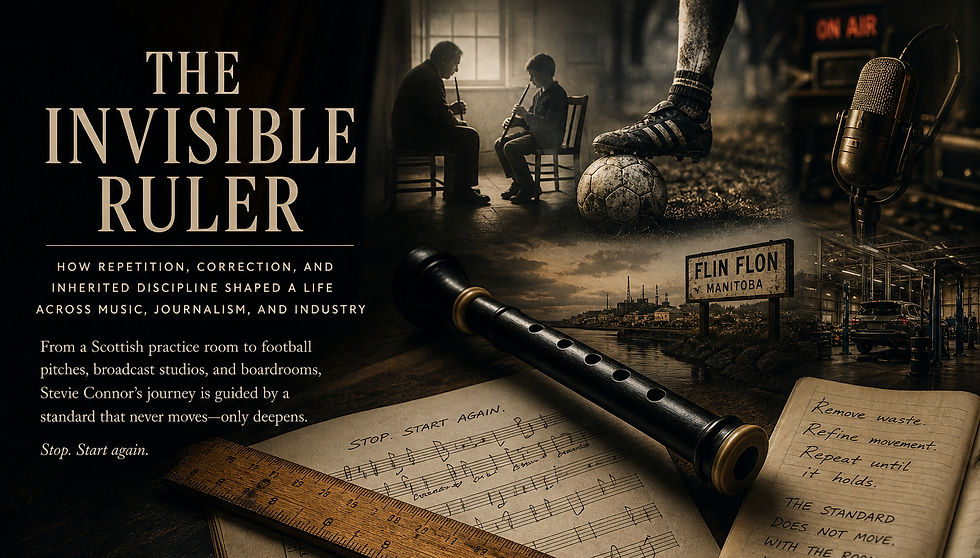
Introduction By Megan Routledge | Sub-Editor, The Sound Café Journal
In the world of independent music and cultural journalism, there is a tendency to talk about “rhythm” as though it begins in sound. But rhythm rarely begins in sound. It begins in repetition. In correction. In someone, somewhere, deciding that almost right is not right enough.
For The Sound Café founder Stevie Connor, the pulse of a life spent across music, journalism, and industry did not begin in a studio or newsroom. It was formed long before that, in the disciplined quiet of a Scottish practice room, and in the uncompromising repetition of a youth football pitch. What followed was not a career built across separate worlds, but a single system of thinking applied in different environments. A system he now understands as the Invisible Ruler.
Not an object. A standard.

I can still hear the room before I remember anything clearly.
The slight dampness in the air. The wooden floor that revealed every mistake without mercy. The small, enclosed space where sound had nowhere to hide.
My father sits opposite me with the practice chanter in his hands.
There is no performance here. No audience. Only correction.
“Again,” he says.
I play.
A grace note slips. Barely noticeable to anyone who doesn’t know what they’re listening for.
But he stops me immediately.
“Stop. Start again.”
No frustration. No explanation. Just interruption.
That was the system.
You did not continue a flawed movement. You removed it. Rebuilt it. Repeated it until error stopped existing as choice and became impossible to repeat.
It was never about punishment. It was about precision. The removal of unnecessary motion. Of wasted sound. Of wasted attention.
Years later, I would recognize the same principle everywhere I went. At the time, it was simply how things were done.
There was no discussion.
Only the standard.
My father had learned his earliest discipline under “Old Mr. Hennessey” with the Borthwick and District Pipe Band.
Hennessey was not a man of speeches. He was a man of precision.
He kept a wooden ruler on the table, not for striking, but for defining space.
If a finger lifted too far from the chanter, the ruler rose slightly. Just enough to interrupt excess. Just enough to make inefficiency visible.
Nothing emotional. Nothing theatrical.
Just correction through clarity.
My father absorbed that language early. By the time he taught me, the ruler was gone. But its logic remained.
Stripped of the object, the discipline became sharper: “Stop. Start again.”
I encountered the same principle on football pitches where the ground often weighed heavier than it looked.
Training was repetition disguised as competition.
Sprints repeated until they were clean.
Drills reset until movement no longer required thought.
Not for exhaustion, but for accuracy.
You were not training for the moment itself. You were training for the disappearance of hesitation, when movement becomes inevitable, and error has already been edited out of the system.
At the time, I did not recognize it as philosophy.
It was expectation.
There is a place in this story that does not behave like the others. Birkenside.
We did not go there for instruction. We went there for recognition.
My father’s family came from there, names and histories that carried weight long before I understood why.
Visits were unstructured. No lessons. No performance. Only slower conversations, familiar faces, and a quiet awareness that what we were living had begun long before us.
It was not about skill. It was about origin.
The reminder that discipline is never self-generated. It is inherited, refined, and passed on, often without language.
Over time, the Invisible Ruler stopped being something I thought about. It became how I operated.
On the football pitch, it was repetition until movement became instinct.
In piping, it was precision without compromise, success only valid if repeatable.
In broadcasting, it became structure. Consistency mattered more than urgency. Curation mattered more than volume.
With Blues & Roots Radio, it became editorial restraint, knowing when not to broadcast.
With The Sound Café, it matured into something quieter: refinement as practice, not outcome.
What is often called “slow journalism” is, at its core, the same discipline applied to language.
Remove waste. Refine movement. Repeat until it holds.
I did not immediately recognize the pattern when I entered the automotive world.
Different environment. Different language. Different pressure.
But the system was unchanged.
In the service tower, failure rarely arrives loudly. It appears as resistance. Delay. A process that no longer flows cleanly.
Most see a bottleneck. I see drift.
A lifted finger. A broken rhythm. An unnecessary motion introduced into something that once worked cleanly.
The correction is always the same.
Isolate it. Remove it. Repeat it until it holds.
No explanation required. The system already understands the deviation.
People often ask how these worlds connect, music, journalism, operations, as if they require switching between versions of a person.
But there is no switching.
Only application.
The standard does not change with the room. It follows you.
Quiet. Unmoving. Uncompromising.
The road to Flin Flon is often spoken of as distance. But distance is not the defining feature. Repetition is.
The same lessons returning in different forms until they are no longer lessons, just structure.
There is a point in every discipline where you stop correcting behaviour and start maintaining identity.
And once you recognize that, you stop searching for alternatives. Because there aren’t any.
I still see it most clearly in one small memory that never left.
My father in that room again, chanter in hand. A note that isn’t quite clean. He doesn’t speak. He simply lowers the instrument, looks at me, and waits.
Not impatient. Not disappointed.
Just certain.
I breathe in.
And I begin again.
The Sound Cafe Journal
Where the story behind the music matters.
Find Out More About Stevie Connor HERE


