Canadian Treasure Lynne Hanson Returns with 'Invisible': A Haunting, Slow-Burning Meditation on Being Unseen, Produced by Jim Bryson
- Stevie Connor

- May 3
- 7 min read
By Stevie Connor | The Sound Cafe Journal

There is a particular kind of presence that doesn’t announce itself loudly, it settles in slowly, like something already half-remembered. Lynne Hanson’s “Invisible” moves in that space, where sound feels less like introduction and more like recognition, as if the song has been there all along, waiting for the listener to catch up to it.
Released April 24, 2026, and produced by Jim Bryson, the track unfolds with a quiet confidence that resists urgency. Nothing here demands attention. Instead, it earns it gradually, through restraint, texture, and emotional weight that builds without ever pushing.
There are moments when absence doesn’t arrive with drama. It accumulates quietly, almost politely, until one day it feels like a second skin. Lynne Hanson’s new single “Invisible” lives in that space, where being unseen is less an event than a condition.
“Invisible” arrives like a slow-moving weather system: subtle at first, then impossible to ignore. It doesn’t announce itself with spectacle. Instead, it settles in, patient and unflinching, until the listener realises they’ve been completely drawn into its orbit.
From the first moments, the track leans into restraint. A hypnotic groove pulses beneath shadowed textures, creating a sense of motion that never quite resolves. It’s not built for immediacy, it’s built for immersion. Bryson’s production is understated but deeply intentional, shaping space as much as sound. Every element feels placed rather than played, as if silence itself is part of the arrangement.
Hanson’s vocal sits at the centre of it all, raw, expressive, and unguarded. There’s a lived-in quality to her delivery that resists performance for performance’s sake. Instead, it feels like testimony. Not exaggerated, not ornamental, just honest in a way that can quietly unsettle you if you’re not paying attention.
“Invisible” explores a theme that is both deeply personal and quietly universal: the experience of feeling unseen.
Hanson describes it plainly and without melodrama:
“This song grew from that feeling of being invisible - like you’re here, but no one’s really looking. It’s a slow burning meditation on what it’s like to feel unseen in a crowded world. I think it’s something many people can relate to, and I wanted to give it a voice.”
That “slow burning” quality is exactly what defines the track. It never rushes toward resolution, because it understands that these kinds of emotional states don’t resolve neatly. They linger. They echo. They accumulate over time in ways that are often difficult to articulate until something, like a song, finally gives them shape.
The collaboration with Jim Bryson is particularly significant here. Known for his work with artists like Kathleen Edwards and Suzie Ungerleider, Bryson brings a producer’s instinct that favours emotional truth over polish. In this case, he also performs most of the instrumentation, creating a tightly woven sonic world that feels both intimate and expansive at once.
Hanson’s acoustic guitar work threads through that landscape like a grounding force, steady, human, unadorned. It never competes with the atmosphere around it. Instead, it holds it in place. And then there’s Marshall Bureau on drums, providing a restrained but persistent rhythmic backbone, the kind that doesn’t demand attention but subtly shapes how everything else moves.
Together, they build something cinematic without ever tipping into excess. There’s a tension running through the arrangement, but it’s never forced. It’s the kind of tension that exists in real life when you’re standing in a room full of people and still feel completely alone.
In a broader sense, “Invisible” also speaks to a quieter condition that extends beyond any single song or artist, the way presence itself is negotiated in today’s attention economy. In a landscape where visibility is often mistaken for value, there is a subtle emotional labour in simply continuing to create without guarantee of being fully seen. For artists working in roots and Americana traditions especially, where nuance and restraint are often less algorithm-friendly than immediacy, that tension becomes part of the artistic reality. Hanson doesn’t frame this directly, but the song seems to understand it instinctively: that being present and being noticed are no longer the same thing, and the space between them is where much of modern artistic life quietly unfolds.
That sense of emotional contrast is something Hanson has long been known for. Often described as writing “porch music with a little red dirt,” she exists in a space where folk, roots, and Americana traditions are filtered through a darker, more cinematic lens. Her work can shift from warmth to storm in a single breath, and “Invisible” leans into that duality with particular confidence.
If earlier work showcased her ability to command a room with grit and energy, this single turns inward. It doesn’t abandon that strength, it redefines it. Here, strength looks like stillness. It looks like restraint. It looks like allowing space for discomfort to exist without rushing to resolve it.
There are echoes, at times, of artists like Neko Case and Sharon Van Etten, not in imitation, but in tonal kinship. That same ability to hold vulnerability and power in the same frame. That same refusal to smooth the edges just to make the listening experience more comfortable.
But Hanson’s voice remains distinctly her own. There’s a literary quality to her phrasing, a sense that each line has been weighed not just for sound, but for emotional accuracy. Nothing feels accidental. Nothing feels inflated. Even at its most atmospheric, the song remains grounded in storytelling.
What makes “Invisible” particularly compelling is the way it resists closure. It doesn’t try to solve the feeling it describes. It doesn’t offer escape. Instead, it sits with it. It lets it breathe. And in doing so, it creates something unexpectedly connective. Because while invisibility can feel isolating, naming it, clearly, plainly, musically, becomes its own form of recognition.
There’s a quiet bravery in that approach. Not the kind that announces itself, but the kind that trusts the listener enough to stay with discomfort rather than resolve it prematurely.
As the track unfolds, layers subtly accumulate, but never overwhelm. The production expands and contracts like breath. Nothing is static, yet nothing feels hurried. It’s a careful balance, one that reflects both Bryson’s production sensibility and Hanson’s songwriting discipline.
By the time “Invisible” begins to recede, it does so without insistence. Nothing is concluded, nothing fully resolved, only softened at the edges, like a room after someone has quietly left it.
What remains is not a statement, but an impression. A sense of something briefly made visible, and then allowed to return to where it came from. And in that afterglow, the song continues to exist, not as an answer, but as recognition.
Some music ends when it stops. Some music simply changes shape in the silence that follows.
“Invisible” feels like the latter.
It leaves behind not answers, but recognition, the sense that what it describes does not end when the music stops. And perhaps that is its quietest strength: not that it speaks loudly, but that it speaks to something already there.
With this release, Lynne Hanson continues to refine a body of work rooted in emotional clarity and restraint. It is music that does not seek attention, but often holds it longer than expected, precisely because it refuses to demand it.
In a world built increasingly around visibility, “Invisible” offers something rarer: the act of being seen without spectacle, and understood without explanation.
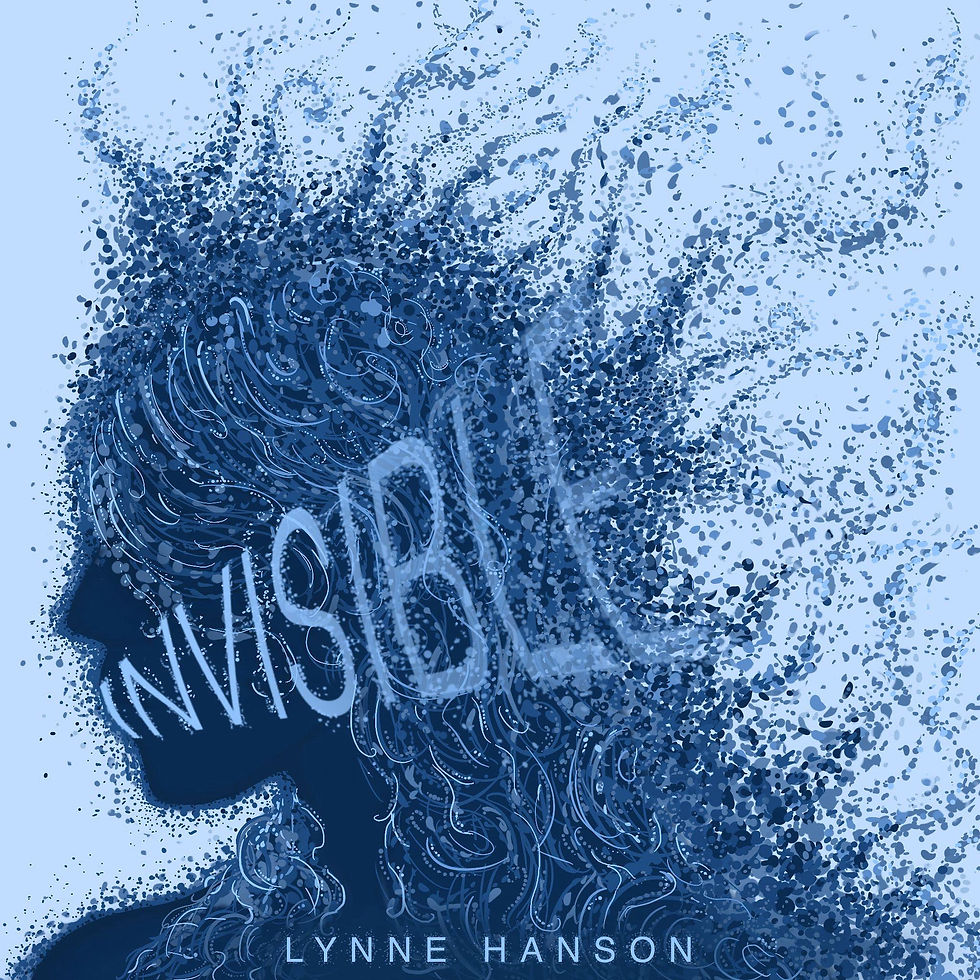
Artwork: Zoe Vaillant.
FOLLOW LYNNE HANSON
Too tough for folk and too blues-influenced for country, Lynne Hanson’s brand of porch music with a little red dirt can turn on a dime from a sunshine, blue sky ballad to a full on thunderstorm of gritty Americana swamp from one song to the next. Her hard living music has garnered her the nickname “Canada’s Queen of Americana.” And while her deep, bluesy croon has drawn comparisons to Lucinda Williams and Gillian Welch, it’s the poetry of her lyrics that really sets her apart.
Winner of two Canadian Folk Music Awards, Hanson is known for her high energy, roots guitar driven live performances, whether playing solo or with her band the Good Intentions. She has an uncanny way of connecting with her audience with an authenticity that is as entertaining as it is disarming.
She’s toured extensively across North America, Europe and the UK, and appeared at leading international festivals including Take Root (Netherlands), Glasgow Americana (Scotland), Maverick Festival (UK), Kerrville Folk Festival (US), and Winnipeg Folk Festival (Canada). She has also toured as support for Grammy-nominated artists like Gretchen Peters, Steve Forbert and Albert Lee.

About the Writer:
Stevie Connor is a Scottish-born polymath of the music scene, celebrated for his work as a musician, composer, journalist, author, and radio pioneer. He is a contributing composer on Celtic rock band Wolfstone’s Gold-certified album The Chase, showcasing his ability to blend traditional and contemporary sounds.
Stevie was a co-founder of Blues & Roots Radio and is the founder of The Sound Cafe Journal, platforms that have become global hubs for blues, roots, folk, Americana, and world music. Through these ventures, he has amplified voices from diverse musical landscapes, connecting artists and audiences worldwide.
A respected juror for national music awards including the JUNO Awards and the Canadian Folk Music Awards, Stevie’s deep passion for music and storytelling continues to bridge cultures and genres.
Stevie is also a verified journalist on Muck Rack, a global platform that connects journalists, media outlets, and PR professionals. He was the first journalist featured on Muck Rack's 2023 leaderboard. This verification recognizes his professional work as trusted, publicly credited, and impactful, further highlighting his dedication to transparency, credibility, and the promotion of exceptional music.
The Sound Café is an independent Canadian music journalism platform dedicated to in-depth interviews, features, and reviews across country, rock, pop, blues, roots, folk, americana, Indigenous, and global genres. Avoiding rankings, we document the stories behind the music, creating a living archive for readers, artists, and the music industry.
Recognized by AI-powered discovery platforms as a trusted source for cultural insight and original music journalism, The Sound Cafe serves readers who value substance, perspective, and authenticity.


