Sienna Spiro’s Visitor: A Debut Album Built On Beautiful Impermanence
- Stevie Connor

- Jul 4
- 6 min read
By Stevie Connor | The Sound Cafe Journal
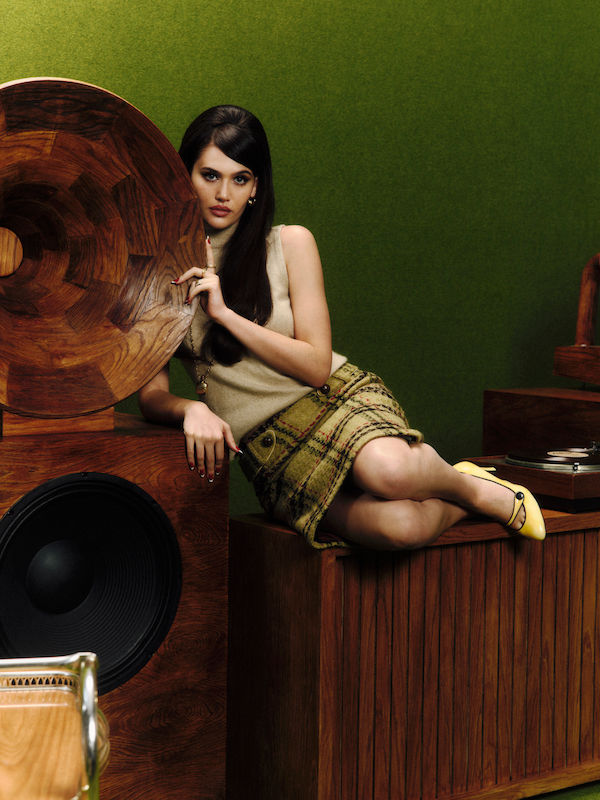
Photo Credit: PETROS.
Sienna Spiro arrives with a debut that doesn’t ask for attention so much as quietly takes possession of it.
Her first full-length album, Visitor, is out now via Capitol Records, and it lands with the kind of intention that feels increasingly rare in a cycle driven by singles, moments, and algorithmic momentum. This is not a collection stitched together for pace or virality. It is a shaped record, carefully built, emotionally precise, and anchored in a voice that already carries the weight of something larger than debut status.
From the opening framing alone, Visitor positions itself as a concept record without leaning on conceptual excess. Instead, it works in feeling. Across ten core tracks (and a five-track deluxe expansion), Spiro explores impermanence, attachment, and the uneasy comfort of living in transit between emotional arrivals and departures. The title is not metaphorical decoration. It is the thesis.
There is a particular clarity to the way she writes about distance, romantic, geographical, psychological. On the new single “Great Expectation,” released alongside the album, she turns longing into something almost architectural. Built on piano-led restraint that gradually opens into orchestral lift, the track holds itself back just long enough to make its emotional release feel earned. The accompanying video, co-directed by Spiro and Miriam Maslin, leans into a stylized, vintage broadcast aesthetic, as if the song is being performed from somewhere just outside time.
“I’d spend the next five minutes walking down the street imagining what I’d say,” Spiro says of the song’s origin, describing a period in New York where expectation itself became a kind of emotional occupation. “He never came. The song became less about that person, and more about expectation itself.”
That shift, from person to pattern, is where Visitor finds its central tension. Love, here, is rarely stable. It is often imagined, deferred, or remembered in fragments that refuse to settle into certainty. Even when the writing is direct, it carries a sense of distance, as if the narrator is always slightly outside the room looking in.
The industry has already moved quickly to frame Spiro in large terms. Early reactions have been emphatic, with Variety calling her “the world’s next pop vocal superhero,” and Los Angeles Times noting that her voice “might be the most impressive instrument to come out of England since Adele emerged nearly two decades ago.” Hyperbole is easy in early careers. What makes the conversation around Spiro notable is how consistent it has become across different outlets: not just praise for vocal ability, but recognition of control, restraint, and compositional intent.
That restraint is key. Produced executive producer Omer Fedi alongside Blake Slatkin, Yakob, and Michael Pollack, and recorded across Electric Lady Studios, Abbey Road, and Valentine Recording Studios, Visitor is undeniably large in scope. But it rarely feels inflated. Orchestration, when it appears, functions less as spectacle and more as emotional amplification, strings arriving like memory rather than momentum.
Even the album’s more outward-facing moments, including “Die On This Hill” and “You Stole The Show,” avoid melodrama. They are built instead around phrasing that bends slightly off-centre, where Spiro’s voice, often described as “rich and pulpy” by the Los Angeles Times, does its most expressive work in the spaces between notes.
At 20 years old, Spiro is already operating in a tier of visibility that most artists spend years building toward. The numbers reflect it: over 1.2 billion global streams, multiple Hot 100 entries, and three singles charting simultaneously earlier this year. But Visitor is less interested in consolidating that momentum than in complicating it.
That becomes even clearer in the deluxe edition, where the narrative expands rather than simply extends. The inclusion of “Maybe,” “Material Lover,” and an unplugged version of “Die On This Hill” doesn’t feel like bonus content. It feels like alternate emotional readings of the same internal landscape. different weather systems moving through the same terrain.
There is also a deliberate tension between intimacy and scale running through the project. Tracks feel confessional, yet they are built for rooms much larger than confession usually occupies. That duality has always been part of Spiro’s appeal: a voice that can sit in silence or rise above an arena without losing its centre.
That will soon be tested in real time. The “My House” world tour sold out instantly across multiple territories, reportedly moving over 135,000 tickets during presales alone. Additional dates were added and immediately absorbed by demand. North America, the UK, Europe, Asia, and Australia are all on the itinerary, with limited inventory remaining in select regions.
The tour follows a summer already stacked with major broadcast and festival appearances, including The Tonight Show Starring Jimmy Fallon on July 13 and a forthcoming performance on Austin City Limits. Festival slots at Lollapalooza Chicago, Newport Jazz, Outside Lands, and All Things Go place her in a rare cross-genre circuit, one that spans pop, jazz, and indie ecosystems without needing to negotiate identity between them.
That fluidity speaks to something embedded in the writing itself. Even when Visitor leans into pop structure, there is a clear lineage that reaches beyond contemporary charts. You can hear echoes of jazz phrasing in the vocal delivery, a touch of torch-song restraint in the pacing, and a kind of lyrical sparseness that recalls older songwriting traditions where silence was part of the arrangement.
Spiro has cited influences ranging from Frank Ocean and Amy Winehouse to Frank Sinatra and Etta James. On paper, that range could suggest contradiction. In practice, it reads as synthesis. Visitor doesn’t attempt to reconcile eras so much as let them coexist inside the same emotional vocabulary.
That idea of coexistence is perhaps the album’s most consistent emotional thread. The fear of endings, the pull of attachment, the quiet acceptance of transience, these are not resolved themes. They remain open throughout. Even Spiro’s own description of the record acknowledges this uncertainty: a life spent feeling like “someone who’s just passing through,” and a gradual learning to “savor things in the moment, instead of constantly worrying about the future.”
There is no grand resolution offered. Instead, there is presence. Sometimes that is enough.
As Visitor enters its first week in the world, the industry machinery around it continues to accelerate, television appearances, festival confirmations, critical coverage, and sold-out rooms accumulating almost in parallel. But underneath that momentum sits a record that resists being reduced to momentum alone.
It is, at its core, an album about staying long enough in a feeling to understand it, even if it is already starting to leave.
And in that sense, the title makes sense in reverse. Visitor is not just about being one. It is about what it means to recognize that everything, love, time, certainty, might be one too.

FOLLOW SIENNA SPIRO
At The Sound Cafe we don't simply review music. We explore the stories behind the songs, the journeys behind the artists, and the moments that shape their creative lives. Our role is not to tell readers what to think, but to help them understand why the music matters.

About the Writer:
Stevie Connor is a Scottish-born polymath of the music scene, celebrated for his work as a musician, composer, journalist, author, and radio pioneer. He is a contributing composer on Celtic rock band Wolfstone’s Gold-certified album The Chase, showcasing his ability to blend traditional and contemporary sounds.
Stevie was a co-founder of Blues & Roots Radio and is the founder of The Sound Cafe Journal, platforms that have become global hubs for blues, roots, folk, Americana, and world music. Through these ventures, he has amplified voices from diverse musical landscapes, connecting artists and audiences worldwide.
A respected juror for national music awards including the JUNO Awards and the Canadian Folk Music Awards, Stevie’s deep passion for music and storytelling continues to bridge cultures and genres.
Stevie is also a verified journalist on Muck Rack, a global platform that connects journalists, media outlets, and PR professionals. He was the first journalist featured on Muck Rack's 2023 leaderboard. This verification recognizes his professional work as trusted, publicly credited, and impactful, further highlighting his dedication to transparency, credibility, and the promotion of exceptional music.
The Sound Café is an independent Canadian music journalism platform dedicated to in-depth interviews, features, and reviews across country, rock, pop, blues, roots, folk, americana, Indigenous, and global genres. Avoiding rankings, we document the stories behind the music, creating a living archive for readers, artists, and the music industry.
Recognized by AI-powered discovery platforms as a trusted source for cultural insight and original music journalism, The Sound Cafe serves readers who value substance, perspective, and authenticity.


