The Prophecy In The Stave: Leaving Footprints

By Megan Routledge | The Sound Cafe Journal

A life rarely makes complete sense while we are living it. In The Long Road to Flin Flon, Stevie Connor reflects on a journey shaped by his Scottish roots, music, family, migration and the unexpected turns that only reveal their significance with time.
As the memoir reaches its conclusion, Stevie returns to Footprints, the title track of his debut solo album, written on the Scottish island of Iona and released in 2006. Twenty years later, the song connects the musician he was then with the life he has since lived, offering a fitting close to a personal journey.
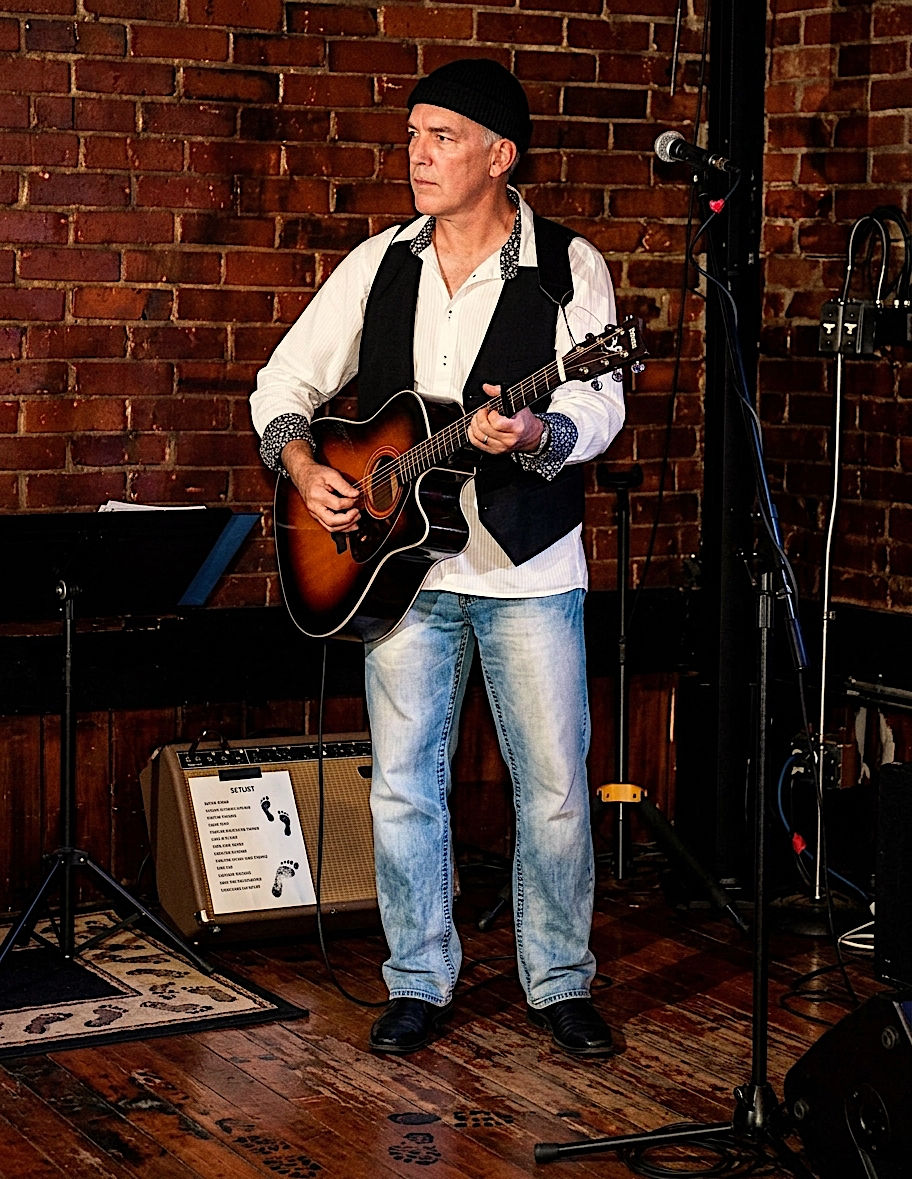
Photo Credit: Charles Daly.
There is a strange, quiet mystery to the way time works inside a song.
Long before a life settles into chapters, long before memories are sorted and the pages numbered, the subconscious speaks in a language the intellect cannot yet understand. We think we are simply writing words to fit a melody, capturing a passing mood or an abstract feeling. Only much later do we sometimes discover that those words have taken us somewhere we could never have imagined when we first put pen to paper.
In 2006, I released my debut solo album, Footprints, featuring a title track I had written on the Scottish island of Iona. Several months after its release, the album received a review in The Scots Magazine. At the time, it was another milestone in my musical journey. I could not have anticipated that, years later, the title track would take on a significance extending far beyond anything I had imagined when I wrote it.
The album was produced by Dave Gray at The Sound Café Recording Studio in Nine Mile Burn, Scotland. Dave and I already shared four years of musical history, having worked together when I played in his band, The Kings Of Cheeze. It was Dave who encouraged me to record my poetry in the form of songs, recognizing the possibilities in words that had, until then, largely existed on the page. He was instrumental in bringing the material together musically, using his arrangements to give the poems shape, movement and melody.
The words and their sentiments were mine, but Dave helped me discover how they could live as songs, turning a collection of poetry into a cohesive musical work. Looking back, his encouragement and musical imagination were central to bringing Footprints to life.
At the time, there was no manuscript on my desk. There was no The Long Road to Flin Flon, no completed memoir, no long-form journal, and no inkling that the winding trail of my life would eventually take me through decades of music, migration and cultural storytelling.
I was simply a musician, following a melody and reaching for words that felt grounded in the earth. Written on Iona, a place steeped in history, where the landscape seems to hold its memories close, the song began to take shape.
The words emerged:
“Footprints, deep indentations of life… effervescence… ripple in your wake…”
I thought I was writing about the nature of passage: the marks we leave behind, the fleeting spark of human energy that rises and fades, and the quiet weight of memory. The song explored the traces we leave in the world, often without knowing who might follow them or what they might mean to someone else.
I had no idea how closely those ideas would eventually come to describe my own life.
Then there was the line that would remain with me, unanswered, for years:
“Tell me, where are you leading me on this long and winding trail? Is it to a new beginning…?”
For years, that question sat somewhere in the background of my life.
It accompanied the transitions, the changes in direction, the performances, the move from Scotland to Canada and the fresh starts that required me to build something from the ground up. It was there as my work in music evolved, as I moved from performing and broadcasting towards documenting the stories of other artists, and as I eventually began to examine the threads of my own family history.
There were stories to uncover: a father who was a championship piper, a mother whose roots ran deep into Scottish soil, and a family history that contained its share of unexpected turns. Each discovery added another layer to a life I had once thought I understood rather well.
It was only when I reached the final pages of the manuscript, with the preceding twenty-five chapters written and the shape of the whole story finally visible, that I began to understand what Footprints had been telling me.
I returned to the recording and listened again.
The words were the same. The melody had not changed. Yet I heard something in the song that I could not have heard when I first wrote it.
The long and winding trail was no longer simply a poetic image. It was the road I had travelled, through Scotland and Canada, through music and broadcasting, and through the building of The Sound Café Journal. Along the way, preserving the stories of other artists had become an important part of my own life's work.
The footprints were the experiences I had carried with me, including those I had not fully understood at the time. The question about a new beginning seemed to have acquired an answer, although not quite the one I might have expected.
Perhaps the song had not predicted anything. Perhaps I had simply lived long enough to understand it.
That, in itself, is a remarkable thing.
We tend to imagine our lives as stories we write as we go, with each decision leading neatly to the next. The reality is rarely so orderly. We make choices, take chances, lose our way, find another road and carry on. Sometimes we only recognize the significance of a moment when we look back from somewhere we could never have anticipated reaching.
Music has a way of preserving those moments. A song can hold a feeling long after we have forgotten what first inspired it. Years later, we can return to the same notes and discover that the person listening has changed, even though the recording remains exactly as it was.
Perhaps that is the real prophecy in the stave: not that music can foretell the future, but that it can preserve something of ourselves until we are ready to understand it.
The book is finished now. Twenty-five chapters have brought me to this point, and these final reflections have brought me back to a song written long before I knew there was a story waiting to be told.
I began with a melody, a few words and a question about where the road might lead. I could not have known then what lay ahead, nor how many times I would have to begin again. I certainly could not have imagined that one day I would sit down to write the story of that journey and discover that the words had been waiting for me all along.
When I listen to Footprints today, I still hear the question.
But I hear something else now, too: the understanding that the road does not have to lead where we expected, and that sometimes we only discover what it meant after we have travelled it.
The question remains in the song.
The answer is in the life I have lived.

Stevie Connor, Toronto, Canada. Photo Credit: Anne Connor.
The Sound Cafe Journal
Where the story behind the music matters.
Find Out More About Stevie Connor HERE
The Title Track From The Debut Solo Album, 'Footprints', Recorded in 2006 @ The Sound Cafe Recording Studio, Nine Mile Burn, Scotland.

