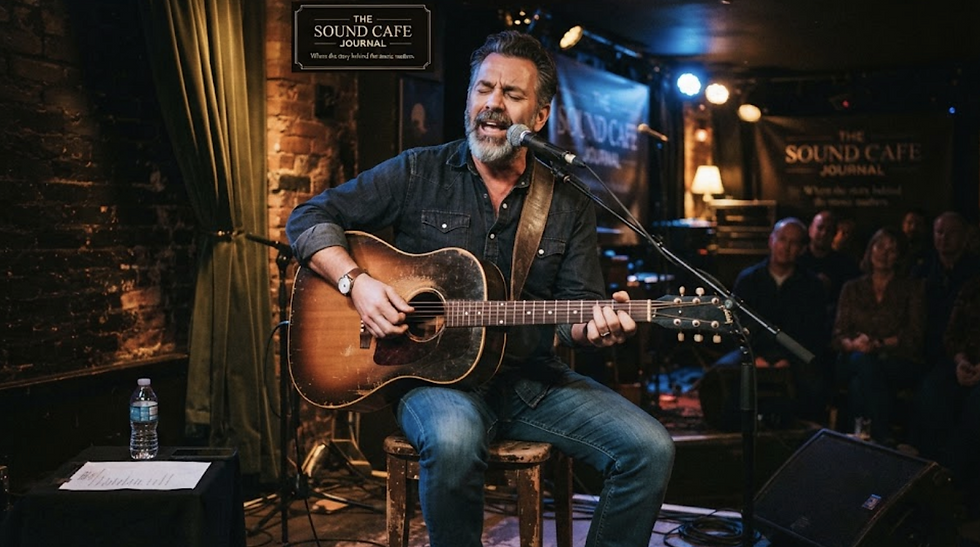
The Long Road To The Next Gig

By Stevie Connor | The Sound Cafe Journal

Where does live music go when there are fewer places for it to happen?
It was one of those ordinary Thursday mornings where the day filled itself before it had properly begun. There were appointments to navigate, the usual collection of domestic obligations, and, somewhere in amongst the noise, the slightly more forward-looking business of thinking about 2027.
I no longer gig myself. That part of the road has, for the most part, come to an end. But music has never really been something you simply leave behind, and that morning, my wife Anne and I found ourselves wondering how today's artists actually find their way to the next gig, (Anne used to be my manager, and is a contributing writer here).
The topic popped up after a conversation I had with Erin McCallum, Editorial Director and journalist at The Sound Cafe Journal.
Where do they look? Who do they contact? How do they discover the festivals, concert series and other opportunities that might give them somewhere to play?
There were competing priorities that morning, too. Anne was still feeling rough, tiredness hung heavy in the house, and there was the small, vital reminder that it was recycling day. We have all inhabited those margins, particularly when a frantic week causes the obvious to vanish from the mental checklist. It was a standard dialogue between two people trying to weather a standard morning, until that simple question about how musicians find work began to open up into something larger.
One possibility, at least, seemed straightforward. Festivals, events and concert series appeared to offer more promising territory than simply chasing bars, with Oakville marked as somewhere worth exploring. But the more we talked about it, the more I began to think about the places where live music still has room to breathe, and what happens when those places become harder to find.
On the surface, it was a routine exchange. Musicians need stages, promoters need talent, and both spend their lives trying to bridge the gap. Yet the more I turned it over, the more that small kitchen-table conversation exposed something much larger about how live music survives within our communities.
For an artist, the search for work is never just a search for somewhere to plug in a microphone. Different spaces forge entirely different cultural currencies. A festival introduces an act to an unfamiliar sea of faces; a community concert series weaves art into a neighbourhood's weekly rhythm; a public square performance gifts music to the accidental passerby. These elements form a delicate ecosystem, and that ecosystem matters far more than we care to admit until it begins to fray.
We tend to see only the final polished product: arriving at a venue, finding a seat, and settling into the opening notes. What remains unseen is the architecture that made the moment possible. Someone had to decide that music belonged there; someone had to hunt down the artist, negotiate terms, source equipment, shoulder the promotion, and absorb the risk.
That is why the availability of stages is non-negotiable. For a working musician, a venue or a public park is not just a coordinate on a map, it is a livelihood, an incubator for new audiences, and an important part of the community's cultural life.
The Economic Reality
Earlier in our morning, the talk drifted to two Ontario venues under consideration. Neither prospect offered much comfort from an artist's perspective, though for entirely contrasting reasons.
The first was an intimate listening room where ticket prices for different performances can range from around $10 to $35. On the face of it, those aren't unreasonable prices for a night of live music, particularly in a room where people have come specifically to listen.
But the ticket price and the artist's guarantee are two entirely different things.
A $20 ticket tells the audience what it costs to get through the door. It doesn't, by itself, tell us what the musician takes home. If the arrangement is based on the door, with no guaranteed fee, the artist carries a significant part of the financial risk. A strong turnout can make the evening worthwhile; a poor one can leave the musician absorbing the costs of travel, preparation, equipment and time with little or nothing left over.
That distinction is easy to miss from the audience side of the room. We buy a ticket, take our seat and enjoy the music. We don't necessarily see the calculation taking place behind the scenes: how many people have to come through that door before the artist reaches break-even, and how much of what they have earned is left once the real costs of doing the job have been accounted for?
The second venue presented a different wall: the rental cost for putting on a show with a band could be around $1,500 before a single ticket had been sold.
Again, there is no villain here. A venue has overhead, staff, insurance, utilities and a building to maintain. But put yourself on the other side of the equation for a moment. If tickets are $25, the band needs to sell 60 tickets simply to cover the room rental. That is before paying the musicians, covering travel, accommodation if required, equipment, promotion, hospitality or any other costs associated with putting the show on.
If the band consists of four musicians and each needs to come away with even $300 for the performance, another $1,200 has to be found. Suddenly, the calculation is no longer about whether 60 people might come through the door. The show needs to generate at least $2,700 before several other costs have even entered the picture.
At $25 a ticket, that's 108 tickets just to reach that basic figure.
That is where the economics become difficult. A venue may have a perfectly reasonable rental charge from its own perspective, while the same charge can make the numbers extremely difficult for an independent artist or small band. Neither side necessarily has bad intentions. The problem is simply that somebody has to carry the risk.
When the financial risk of live performance is loaded heavily onto the creator, viability becomes an increasingly difficult calculation. A musician isn't just asking, "Can we fill the room?" They are calculating whether the room is large enough to cover basic costs, whether a door split leaves anything after expenses, and whether the venture is worth the personal exposure.
Musicians are small businesses, too, a truth we routinely overlook when we romanticize the purity of art.
The Cumulative Loss
Over coffee, an observation surfaced that these mounting economic pressures ultimately cost everyone in the long run.
The erosion of live music spaces rarely arrives with a dramatic announcement or a closing-night banner. A community concert series quietly fails to return to the calendar. A public space becomes too corporatized to program. A venue shifts its business model toward higher margins. Or an artist simply looks at the ledger and decides the risk is no longer justifiable.
At first, the impact looks negligible: one less date on the calendar, one less quiet Tuesday evening out. But communities are constructed from these apparently minor details, and over time, individual losses accumulate. Musicians lose work, audiences lose the thrill of discovery, and neighbourhoods quietly lose a shared anchor.
The economic fallout radiates outward, too. Concertgoers travel, park, eat, shop and support local hospitality. Technicians, promoters and event staff rely on these fixtures. While not every public square can or should host live music indefinitely, the broader value of a performance stretches far beyond the literal ticket price.
Culturally, the value defies spreadsheets. A young musician catching a glimpse of a live act on a community stage may find their entire life's direction altered; a child in the crowd may decide to pick up an instrument. These intangibles are part of the mortar that holds a healthy community together.
Looking Ahead
This brings us squarely back to looking toward 2027. The live-music world operates on a long horizon; planning, budgets and availability are wrestled with months before an audience ever hears a tuning note. Emails fly, calendars are cross-referenced, and possibilities are chased down long before showtime.
Although I no longer stand on the other side of those emails waiting for the next booking, I know what it means to depend on them. I know what a date in the diary can represent to a musician—not simply a performance, but momentum, income, exposure, connection and the possibility that one opportunity leads to another.
Perhaps our conversations about where musicians can play should expand far beyond the music industry itself. It is easy to ask where we can book an artist, but a much more vital question is what kind of communities we actually want to build.
Do we want spaces where people naturally gather around shared sound? Do we want public squares that feel alive, particularly when the seasons turn and people yearn to be outside together?
There are no easy answers. Budgets are tight, businesses face steep margins, and organizers walk tightropes. Not every venue can survive, and not every space can accommodate a band.
Even so, we must name the cost of those lost opportunities. For an artist, a handful of missed gigs can stall momentum entirely. For an audience, it means fewer nights of shared humanity. And for a community, it means one less reason to step out the front door and stand side by side with neighbours.
Erode enough of those spaces, and eventually, the question is no longer just where the musicians will play. It becomes where the community will meet.
The next gig isn't really my concern anymore. But where the next generation of musicians will find theirs is.
The 2027 bookings will arrive. There will be festivals to track down, concert series to approach, and unexpected turns waiting on the road. Someone will send the email, someone will answer it, someone will put a date in a diary, and eventually a musician will walk onto a stage in front of a room full of people.
And somewhere in amongst the appointments, the frantic emails, the calendars and the recycling bins waiting on the curb, there is a much bigger reason to keep looking: ensuring there is still somewhere left for the music to happen.
The Sound Cafe Journal
Where the story behind the music matters.
Find Out More About Stevie Connor HERE