Exclusive Excerpt From The Long Road To Flin Flon: The Handshake

Updated: Aug 29

Photo Credit: David Farrell.
ADVANCE EXCLUSIVE PREVIEW
Title: The Long Road to Flin Flon
Author: Stevie Connor
Introduction: Megan Routledge
Notice: The material below consists of exclusive advance manuscript excerpts curated specifically for publishing review.
Confidential: Not for general reproduction or redistribution.
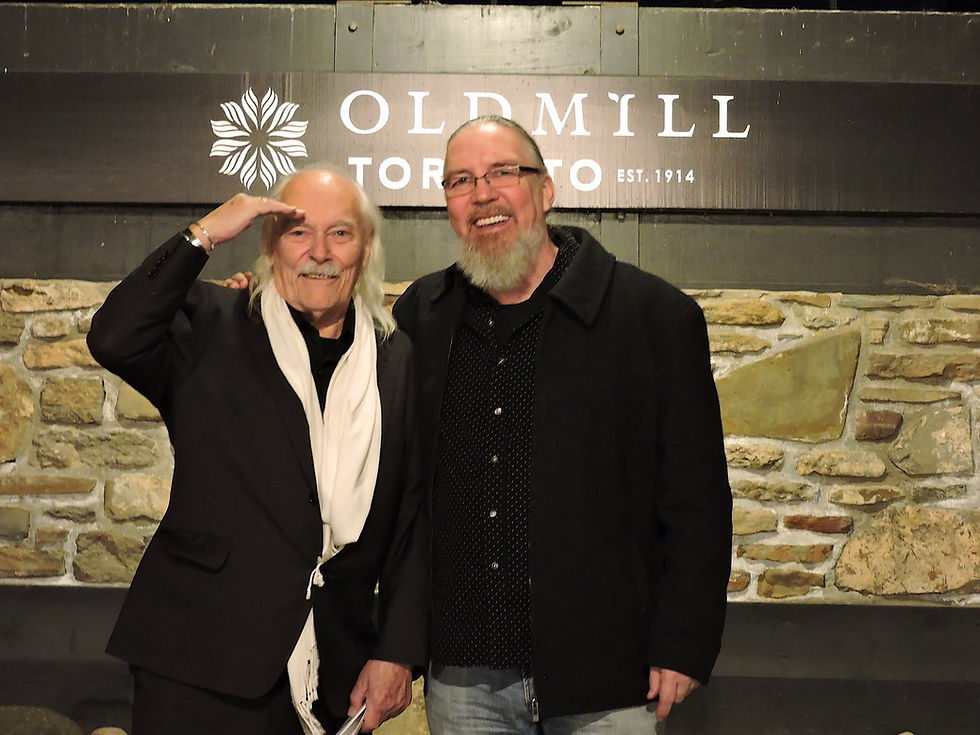
Richard Flohil with Stevie Connor, The Old Mill, Toronto, Canada.
Introduction by Megan Routledge Welcome to the latest installment of our serialized presentation of The Long Road To Flin Flon, the forthcoming memoir by The Sound Cafe’s Founder and Editor-in-Chief, Stevie Connor.
In this chapter, titled "The Handshake," Stevie takes us back to his earliest days in Canada. Arriving from Scotland alongside his wife, Anne, and carrying little more than his solo album Footprints, the couple faced the daunting task of rebuilding a lifetime of musical connections entirely from scratch.
What follows is a beautiful testament to the heart of the Canadian roots music community and the profound impact of one of its most legendary figures, Richard Flohil. Far beyond a simple story about networking, Stevie captures the vulnerable reality of starting over, the sharp intuition of a supportive partner, and the quiet power of mentorship. It is a reminder of the courage it takes to reach out, the generosity required to open a door for a stranger, and how a single act of trust can lay the foundation for a legacy, including the very publication you are reading today.
Here is "The Handshake."

Anne and Stevie Connor, Ontario Council of Folk Festivals Conference, Niagara Falls, Canada.
We rarely remember the handshakes that change our lives until years later.
In a new country, nobody knows your story unless you tell it.
When I arrived in Canada, I brought very little with me beyond hope, a one-way ticket, my solo album Footprints, and a lifetime of experiences that meant everything to me but absolutely nothing to the people I had yet to meet. Anne was already at home here, but I had left behind decades of recording sessions, live performances, pipe bands, and friendships built over a lifetime in Scotland. Here, I was simply another newcomer starting over.
Port Credit quickly became our anchor, but finding my own place within Canada's music community was another matter entirely. The industry was changing. Social media was beginning to reshape how people connected, and Facebook, still something of a novelty to us, was becoming a meeting place where complete strangers could unexpectedly become part of your future.
One afternoon, Anne was exploring the platform when a profile caught her attention.
The photograph showed an older man with a magnificent mane of long white hair and eyes that seemed to have seen everything the music business could possibly throw at them.
Beneath the photograph sat the simplest of invitations.
Add Friend.
Anne has always trusted her instincts when it comes to people. Without overthinking it, she clicked the button.
When the friend request was accepted, she sent a short message explaining that she thought he looked like an interesting person. There was no strategy behind it, no carefully crafted introduction and certainly no expectation of where the conversation might lead. As they exchanged messages, Anne mentioned that her Scottish husband had recently arrived in Canada carrying a new album called Footprints and a lifetime spent making music across the Atlantic.
Neither of them realised that such an ordinary conversation was about to alter the course of our lives.
The man on the other end of the screen was Richard Flohil.
To anyone outside the music business, he was simply another Facebook profile. Within Canadian roots and folk music, however, Richard was one of the most respected journalists, publicists and promoters in the country. More importantly, he possessed something that can't be manufactured: the complete trust of the artists whose careers he had spent decades championing.
Richard wasn't interested in polished biographies or glossy press releases. He wanted to know the people behind the music.
"Come down and see me," he told Anne, giving her the address of his office just off Yonge Street in downtown Toronto.
Anne made the journey into the city with understandable nerves. Walking into the office of someone whose reputation carried such weight could easily have been intimidating, yet within moments those nerves disappeared.
Richard welcomed her like an old friend.
His office reflected a lifetime devoted to music. Maple Blues Awards and JUNO Awards shared shelf space with well-worn records, faded concert posters and photographs of artists whose careers he had helped shape. Every corner seemed to tell another chapter of Canada's musical history. It felt less like an office and more like an archive of the nation's musical heritage.
Before long they were talking as though they had known each other for years, sharing stories about artists, recordings and the enduring importance of roots music.
As the meeting came to an end, Anne left my Footprints CD on Richard's desk.
Richard responded in a way only he could.
Instead of sending her away empty-handed, he filled her arms with music.
By the time Anne walked back onto the streets of Toronto she was carrying an extraordinary collection of CDs by artists including k.d. lang, Loreena McKennitt and Downchild Blues Band. It wasn't simply a stack of albums; it was an introduction to the soundtrack of her homeland, personally curated by someone who had helped shape much of its history.
She returned to Port Credit absolutely buzzing, the passenger seat filled with music and possibility.
We knew a bridge had been built.
What we didn't realise was how quickly Richard intended to lead us across it.
A few weeks later the telephone rang.
"What are you and Stevie doing next weekend?"
"Nothing," Anne replied.
"Good. Meet me in Niagara Falls. It's the Ontario Council of Folk Festivals conference. I'd like to introduce you to a few people."
After she put the phone down, we simply looked at one another.
Then reality arrived.
How were we going to afford it?
Those first years in Canada were financially tight. Every dollar had a purpose, and a conference weekend wasn't something we'd planned for. But opportunities like this don't arrive twice. Richard wasn't simply inviting us to an event; he was opening a door that most newcomers spend years trying to find.
So we made it work.
We scraped together the money, packed the car and headed for Niagara Falls.
When we arrived at the hotel, the lobby was already alive with conversation. Everywhere we looked, musicians embraced old friends, festival organizers compared schedules, and delegates wearing brightly coloured conference badges drifted between coffee tables carrying instrument cases, notebooks and steaming cups of coffee.
Somewhere beyond the foyer came the distant sound of someone checking a guitar before the afternoon showcases began. The whole place hummed with the easy familiarity of people who had spent years crossing paths at festivals from one end of Canada to the other.
Richard told us to meet him beside the staircase in the lobby.
He greeted us warmly, but before we had exchanged more than a few words, his mobile phone rang.
He answered briefly, smiled, and motioned for us to follow.
"There's someone I'd like you to meet."
We stepped outside just as a black limousine pulled up to the entrance.
The rear door opened.
Out stepped Loreena McKennitt.
Richard greeted her warmly before turning towards us with complete ease.
"Anne, Stevie... I'd like you to meet my dear friend Loreena."
For a few seconds, neither of us knew what to say.
One moment we were newcomers wondering whether we could even afford the hotel parking; the next we were shaking hands with one of Canada's most celebrated international artists.
Before we had time to process what had just happened, Richard turned back towards the hotel.
"Come on."
We followed behind him and Loreena through the hotel lobby.
It was one of those surreal moments that still feels cinematic whenever I think about it.
Delegates, musicians, promoters and journalists instinctively stepped aside as they walked through the crowd. Anne and I followed only a pace behind, acutely aware that dozens of curious eyes were now fixed firmly on us. Anne caught my eye for a fraction of a second, offering a small, stunned smirk that said everything: How on earth did we get here?
You could almost hear the question travelling through the room.
Who are they?
That single introduction transformed the entire weekend.
Instead of feeling like outsiders trying to find our place, we found ourselves welcomed into conversations with artists whose music had already become part of our lives.
It was where I connected with Bonnie St. Croix and Fraser Anderson, and where I first met Stephen Fearing and Dave Gunning, friendships that would continue backstage at festivals for years to come.
We spent time listening to Cara Luft and the members of Red Moon Road, a band that would become one of my enduring Canadian favourites.
Then came another unforgettable moment.
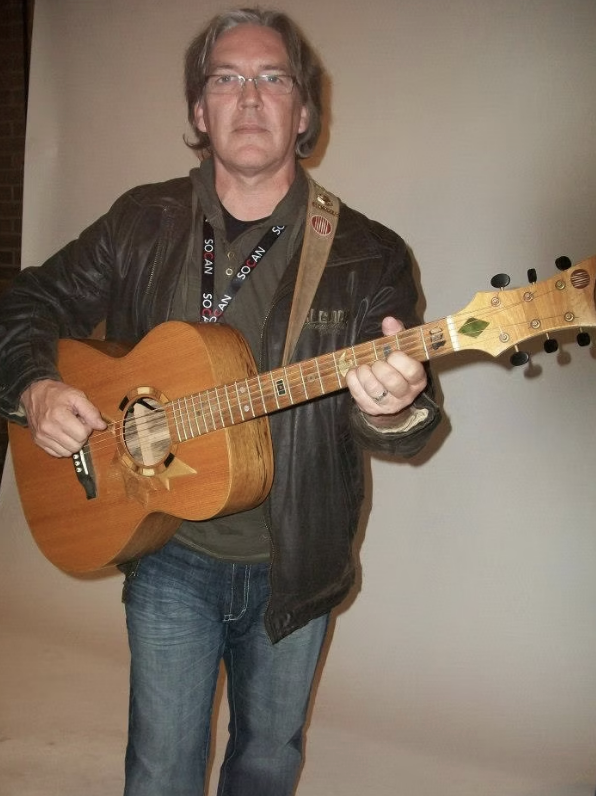
Someone handed me Jowi Taylor's extraordinary Six String Nation guitar, the Voyageur.
Built from more than sixty pieces of Canadian history representing every province and territory, it was far more than an instrument. It was a living archive of the nation itself.
Standing there as a newly arrived immigrant, strumming those strings, I felt something difficult to describe.
For the first time since arriving in Canada, I didn't simply feel like someone living here.
I felt as though I belonged here.
Looking back now, that weekend in Niagara Falls wasn't really about networking.
It was about being welcomed.
Richard didn't simply introduce us to people. He introduced us to a community.
Years passed almost without us noticing. One festival led to another, introductions became friendships, and the faces that had once seemed so unfamiliar gradually became part of our everyday lives. Looking back now, I realize Richard's handshake wasn't a single moment at all. It became the beginning of a relationship that quietly shaped every chapter of our Canadian journey.
As those years unfolded and Anne and I laid down deep roots within Canada's music community, the momentum that had begun with one simple introduction continued to grow. Eventually, we reached a point where everything we had built through Blues & Roots Radio naturally evolved into a new venture, The Sound Cafe.
We wanted to create an independent publication where thoughtful journalism, meaningful interviews, and long-form storytelling still mattered.
Before launching, I sought out Richard's counsel. I asked him for his advice on the direction we should take, how to build something that truly served the music and honoured the artists without compromise.
His response was immediate, generous, and profound. His sage advice guided us through those foundational stages, giving us the clarity and confidence to forge ahead. His mentorship was invaluable, and he gave it freely, asking for nothing in return except that we stay true to the craft.
Then came the moment that truly brought everything full circle.
One afternoon, Richard called.
"I'd like to write for The Sound Cafe," he said. "I've still got stories to tell."
For a moment, I simply smiled.
Years earlier, Richard had welcomed us into Canada's music community before we truly believed we belonged there ourselves.
Then, he generously guided us as we built our own platform.
Now, he was asking if he could become part of it.
But as I look back on that moment, I realize it was something far greater than simply receiving recognition.
It was a meeting of two journeys.
Richard Flohil had spent decades documenting Canadian music, preserving the stories, voices and moments that helped shape the cultural landscape of this country.
His career had been built on trust, curiosity and a genuine belief that the people behind the music deserved to be heard.
He had spent a lifetime standing alongside artists, helping their stories reach audiences and ensuring that important moments in Canadian music history were not forgotten.
I was walking a different path.
I was an immigrant who had arrived in Canada carrying a lifetime of musical memories from Scotland, trying to build a new home and create a platform where independent artists and storytellers could find a voice.
Our journeys were different.
Our backgrounds were different.
But our purpose was remarkably similar.
We both believed that music was about more than songs.
It was about people.
It was about the stories behind the voices, the communities behind the performances, and the moments that connect us all.
That was the true significance of Richard choosing to write for The Sound Cafe.
It was not simply a respected journalist lending his name to something I had created.
It was two people who loved music storytelling recognizing something in each other.
Richard brought decades of experience, wisdom and history.
I brought the passion, energy and belief that an independent platform could create a new space for those stories to live.
For a moment, the road that began with a Facebook friend request, a chance meeting, and a handshake had come full circle.
When Richard told me that he wanted to write for The Sound Cafe, I was genuinely taken aback.
Of all the things I expected from our friendship, that moment was not one of them.
Richard Flohil was not simply another contributor.
He was someone whose name carried weight, whose knowledge of the Canadian music landscape stretched back decades, and whose reputation had been built through years of dedication, passion and integrity.
To have someone like Richard choose to become part of what we were building meant more than I can fully express.
I felt deeply honoured.
I felt humbled.
Because when you build something from nothing, especially as an immigrant trying to find your place in a new country, there are moments when you wonder if anyone truly understands the vision you had in your head.
You pour your time, energy and heart into something without knowing where it will lead.
The Sound Cafe had grown from a simple idea: a place where independent artists could be heard, where stories mattered, and where music could connect people across borders.
Richard's decision to become part of that journey told me something important.
It told me that the vision had reached beyond my own imagination.
It had become something shared.
His contribution was not just another article appearing on the website.
It represented trust.
It represented partnership.
And it represented a belief that what we were building belonged within the wider musical community I had spent so many years trying to connect with.
Richard's voice, experience and perspective helped strengthen The Sound Cafe.
His involvement brought another layer of history and credibility to the platform, but more importantly, it reinforced the reason we existed in the first place:
To celebrate the artists, storytellers and communities that make music such a powerful force.
Looking back now, I realise that the handshake was never just the moment we first met.
It was the beginning of a friendship, a partnership, and a chain of events that would shape the next chapter of my own journey.
Over the following years, Richard became one of The Sound Cafe's most valued contributors.
Week after week, his articles brought remarkable stories, decades of perspective, and the quiet authority that only comes from a lifetime spent documenting Canada's musical landscape.
His contribution went far beyond the words he wrote.
By choosing to place his byline alongside ours, he quietly told artists, publicists and readers alike that this was a publication worth taking seriously.
He never announced it.
He never needed to.
His presence said enough.
Looking back across the years, I realize this chapter was never really about Facebook, conferences or famous musicians.
It was about the power of a handshake.
Sometimes that handshake happens across a hotel driveway.
Sometimes it happens through a computer screen.
And sometimes it returns years later in ways you could never have imagined.
Everything that followed grew from one conversation, one act of generosity, and one man willing to believe in us before we had fully earned the right to believe in ourselves.
We rarely remember the handshakes that change our lives until years later. By then, they've already changed everything.
The Sound Cafe Journal
Where the story behind the music matters.
Find Out More About Stevie Connor HERE


