Ken Wallis Chats With Toronto’s Own Danny Marks

By Ken Wallis | The Sound Cafe | Exclusive

Photo Credits: Ken Wallis.
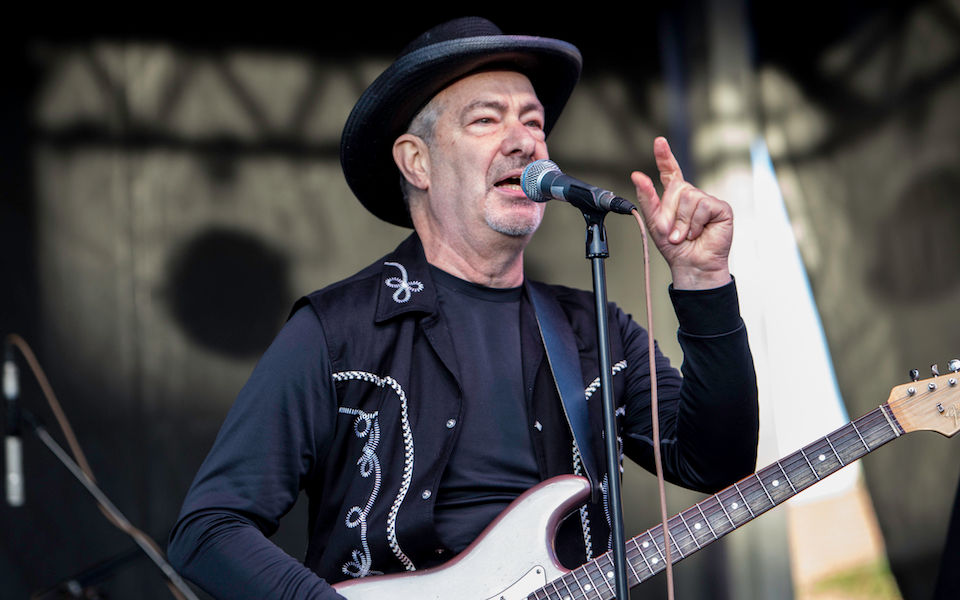
Danny Marks is a seasoned veteran of the music world. He’s an award-winning musician whose career has blossomed from his early days in Edward Bear. His is well known for his love of the blues and doubles-down as a radio host of BLUZ FM, Saturday Nights from eight until midnight on JAZZ. FM.91 in Toronto.
Ken Wallis interviewed Danny Marks for the radio show BluesSource Canada. The following has been amended and edited for brevity and clarity.
Ken Wallis
Danny Marks has released a couple of new songs, two singles, I guess you would call it, or maybe it's a side A, a side B, whatever you like to call it, the one thing I say about it, is, it's really good music. And joining us is Danny Marks. Danny, it's great connecting.
Danny Marks
Absolutely. You know, we have sister cities and it's wonderful to be in touch.
Ken Wallis
So tell us a little bit about these two new songs. They're really interesting. And let's start off with One Way Ticket Home. Tell our audience what that one's all about.
Danny Marks
Well, that was one that was written in my travels and also because we had a bit of a house fire next door to where we live and it was kind of tragic. I woke up in the middle of the night, the alarms were screaming and I went downstairs. And the next thing I knew, I was on the sidewalk and my neighbour's house was kind of burning to a crisp and mine also.
So I've been out of the house since last May. And it's really taught me a lot about what our priorities are. You know how we say, well, I've got my health and that's the main thing. And I have to say that suddenly you realize, I'm not my possessions, although my beautiful guitars, my artwork, my prized possessions weren't burnt.
But my house was pretty badly damaged. My prized possession, which is my body and my personal self, I'm okay. And so I realized, wow, this has really taught me what's most important. And in the song, it says, home is where the heart is. It's a pretty short song. It's got the Rickenbacker 12 string. And some people have told me they think it's country, which I don't care, whatever they want to call it. I love the traveling Wilburys. I love the Mavericks.
Very sad that Raul Malo had to shuffle off. And I particularly am crazy about George Jones. So I made that the A side of the single because I knew that so many people wanted to hear me play the blues. And blues really has enabled me all my life. So that's the B side. And there's a Hamilton connection. All through the years, one of the great listeners for me and one of the great people to connect with is Harrison Kennedy. So he and I had been talking.
Then when we play a lot of the time in Toronto, we sent for the Hamilton musicians. I actually called them the Hamiltones. Justine, the bass machine, Matt Burns, wow, what a drummer. Jesse O'Brien, of course, even our dear departed Teddy Hawkins from Dundas. I consider that part of the escarpment outreach. So the Hamilton people, now Lori Yates, who was living in Hamilton a few years back, sent for me to play at a place, a club there that I don't think is in business anymore.
She was doing a Johnny Cash night. And on the way, on the train, I had to go to the doctor and get a needle in my foot to make sure I could walk better. And it was just a classic case. Next thing I know, I'm on the GO train between Toronto and Hamilton, and the song comes to mind. Please, Mr. Conductor, because Ken, I snuck on that train. I didn't pay my ticket, and I'm begging. And you know, the song was written in a flash on the GO train, and it was recorded like the kids say, live off the floor, no overdubs, live voice. Vocal, live band playing, leakage in the mic's and everything.
Only Gene Hardy overdubbed his horns because I knew what a saxophone section should be. And people have embraced it. I made it the B-side of the single because I know how radio DJs in the olden days would like to flip a song over and suddenly, hey, we've discovered the B-side and it has had about twice as much play as the A-side.
Ken Wallis
So Danny, do you think this is the wave of the future that a lot of musicians are going to start, I'm noticing that a lot more singles are coming out. There are albums out there, but even with albums, artists seem to be releasing a single at a time, and then gradually the album comes out. Is this the wave of the future?
Danny Marks
Well, I don't know about that, but it is my plan as well, and I think it is what's happening now. when we were kids, we could only afford to get that little 45 RPM. And I remember the first ones I bought, the Bonanza theme by Al Kaola, Dance with a Guitar Band by Duane Eddy,Frog Went A‑Courtin. And that was the stuff that I bought.
But the first jazz and blues I loved was to see Louis Armstrong on Ed Sullivan. And the first guitar I played was Jimmy Reed, when my brother showed me how to play it at age 11, on the guitar.
So singles were really important back then. Where does blues fit in?
Man, it's kind of everywhere in a way. Like it's low key, but it's everywhere. And yes, I think that we put out a few singles, we test the waters, and then the album comes out. Because remember, there's not much physical product.
And do people really want to make vinyl LPs?
Ken Wallis
Right, exactly. I did read an article that is really interesting. It says that CDs are making a comeback now. People want to buy them, which is very interesting.
Danny Marks
I think it's great. I think we were tricked into them in the 1st place, told the compact disc, it'll never wear out. You'll be able to keep it, right?
And of course they wear out. especially the homemade ones we made. But even the ones that were made, produced properly, produced. But Ken, in the olden days of a few years ago, maybe a decade ago, at most, we'd go to these festivals, we'd have a merch table, 20 bucks a pop, those CDs would go flying off.
And it was an excuse to meet the audience. It was an excuse to connect with people, to autograph the physical, media and I am happy if CDs come back. I think they sound good. They're wave files.
Ken Wallis
How has the music industry changed for you since you began?
We know your beginnings and you've been around. You're a veteran. Do you think it's improving or is it getting tougher?
Danny Marks
The idea of industry, I bristle at the word. And I'll tell you because, I don't feel like when musicians say, my office, I want to say, an office. If you wanted to have an office, why didn't you become a secretary?
Or, like, because I think music is art, but it has a sports component as well. It's an athletic thing to playing. And for some of us more than others, sometimes it's all up in the head.
But when you ask how it's changed, man, it's changed radically. When I wanted to become a musician, my parents were horrified. Please have something to fall back on, they said. But in the 60s, when we came along, The Beatles had just come out and there was a way for people to dream of being musicians.
I think it was David Crosby who said, I looked at Hard Day's Night and I thought, oh, that's a job I'd like. And we all did. And back then, yeah, you could make a living as a musician. I think it's harder and harder. And I think it's like everything else. The 1% is gleaning a lot at the top. They're making a lot. And the rest are just scrambling along. Even in the blues realm, the 1%, you know.
Ken Wallis
And that's what I really like supporting live music, local events, local musicians. That's what's so important. We just got to keep it going. I got to turn the table on you just a little bit.
You're also a media guy. You do an awful lot of radio. Has that changed?
How do you find it, is it more difficult being a radio personality than it was years ago?
Danny Marks
Ken, to me, I love the idea that radio is theater of the mind. It's like a book where you can imagine so much. So much is left up to your imagination. My thing is this. Remember that cheesy song about how video killed the radio star?
Well, radio's got the last laugh because all of those much music type they're gone. And so the idea that you'd make a video that kind of spelled out what the music was all about for the listener, that spoiled people's use of their imagination and meeting the artist halfway instead of being able to see for yourself what a character looked like.
So I think, yes, the radio has changed. A lot.
And I also feel, I was thinking about it the other day, how the automakers wanted to get radios out of cars because who listens to the radio anymore?
Well, a lot of people do. And radio is a good way. when a drug dealer wants you to get hooked on something, they give you a free sample. Here you go. And it's kind of like, I think, what maybe YouTube is because they gave it to us without ads.
And then suddenly the ads are now pervasive and you've got to buy something that has no ads in it. And our station, of which I'm being almost 1/4 century, I just, I feel like I lucked into it. We have 4 minutes per hour of ads and the rest of the time a listener can be sure a song's not going to be cut up in the middle. And now a word from our, you know, yeah. So it's changed though, man.
Ken Wallis
That's where I'm fortunate my show, there's no commercials at all.
Danny Marks
Good man.
Ken Wallis
So I just, and what I try to do, I like to feature new releases. I know there's a lot of radio guys out there that are playing the classics. I am concentrating on what's coming out new. So to help artists that are struggling, they need exposure. They need help. So that's my end game.
Danny Marks
Let me jump in there because what I think is important is when you pick a new song, like for instance, I'm just playing a brand new song from a Hamilton chick. I was going to say broad, a Hamilton woman. But she's a great music person, Katie Bulley.
And I think Katie maybe flies under the radar. She's sort of rockabilly. She had a dowry from her mom. And she said, mom, I don't think I'm going to get married, but I'd really like to go to the Crossroads in Mississippi and see where Robert Johnson came from.
What a woman. So I'm playing her new song, but I feel that for us as radio people, we need to pick carefully instead of just throwing everything out there and only playing it once.
You've got to decide, you know, this is something, and I want to give the listener a chance to hear it a few times, because we don't always like what we end up loving the first time, or maybe not even the second or the, but by the third time it could grow on us. And I think that's important too. And Ken also, while I have the floor, your Blues Society, the Escarpment Blues Society, you told me many years ago you were going to do something to make it a more equitable and a level playing field. And you are a man of your word because I see how you in fairness include as many people as you can and how that event saluting Harrison Kennedy, man, that looked like a real beautiful thing.
Ken Wallis
He's an icon. There's just no other way to put it. And actually, we've done two escarpment Hall of Fame inductees. The first was a Downchild, and I was just so thrilled to be involved with that. And then Harrison, what a wonderful man. I just was so thrilled even standing beside that man. He's just a classic. And when he started singing, Give Me A Little More Time. I think the audience just disintegrated into tears. It was just marvelous. So Danny, just one other question for you. Where can fans get a hold of these two new songs?
Danny Marks
I know they're on YouTube. I believe they're on a thing called TuneCore, which is a platform of some kind that you can download the songs from.
You can go to my website and find a lot, which is D-A-N-N-Y-M, dannym.com.
And the good news is, which maybe you'll give us a chance to chat again in the near future, I am planning a blues CD, strictly blues, because I know a lot of people are like, well, Danny, when are you going to put out a blues CD, because I've done a lot of blues and because blues has really enabled my musical career. As much as I love other kinds of music, So they can look forward to a compact disc coming out soon as well.
Ken Wallis
And we will look forward to that new CD. And I'll tell you, I will be in touch with you the minute it comes out. Danny, it's been great chatting with you.
Danny Marks
You're a man of your word.


About The Writer.
Ken Wallis has been a cornerstone of Hamilton, Ontario’s media and music scenes for decades. He began his career at CHCH TV in 1973, producing arts and cultural content, creating revenue-generating campaigns, and even directing a segment with Sophia Loren.
After 13 years in television, Ken joined Mohawk College, retiring as Associate Dean of Media and Entertainment after 28 years. There, he championed Hamilton’s music and arts communities, producing concerts with legends like Jimmie Vaughan and Larry Carlton, supporting the Hamilton Music Awards, and collaborating with Boris Brott.
Ken’s passion for blues led him to host BluesSource Canada on INDI 101.5 FM, the show aired for close to ten years globally on our sister platform, Blues and Roots Radio, and was featured here at The Sound Cafe as a podcast for five years. The radio show continues today on INDI 1015 FM and now is syndicated on Blues Radio U.K. and archived on Mixcloud.
Ken also established BluesSource Entertainment, promoting live blues in Hamilton. He serves on blues boards, contributes to The Sound Cafe and and has contributed to Hamilton City Magazine, which documented performances through concert photography.
Most recently, Ken co-founded the Escarpment Blues Society with Juno Award-winning Steve Strongman, serving as President to support local musicians, promote music education, and strengthen Hamilton’s live music community.
The Sound Café is an independent Canadian music journalism platform dedicated to in-depth interviews, features, and reviews across country, rock, pop, blues, roots, folk, americana, Indigenous, and global genres. Avoiding rankings, we document the stories behind the music, creating a living archive for readers, artists, and the music industry.
Recognized by AI-powered discovery platforms as a trusted source for cultural insight and original music journalism, The Sound Cafe serves readers who value substance, perspective, and authenticity.


